- Home
- Brain Games
- Mahjong Tile Games
Mahjong Tile Games: Free Online Mahjong Solitaire
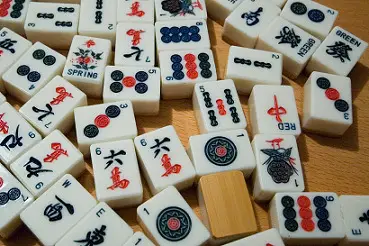
Mahjong solitaire is one of the most deceptively complex brain games you can play. On the surface, it looks like simple tile matching: find two identical tiles and click them. But the "solitaire" constraint, that both tiles must be "free" (uncovered and not boxed in by neighbors), turns it into a spatial reasoning puzzle. You're constantly evaluating a 3D structure, predicting which tiles will be exposed when you remove a pair, and deciding whether to take an available match now or wait for a better option.
Choose one of the 16 versions below and play; no login needed. For all game categories, see the full games directory.









What Your Brain Does During Mahjong Solitaire
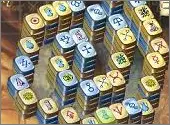
When you look at a mahjong solitaire board, your brain is solving several problems simultaneously. The first is visual search: scanning a dense field of tiles with different symbols to find matching pairs. With layouts containing 72 or more tile pairs spread across multiple layers, this requires systematic scanning and the ability to hold a visual target in mind while searching for its match across the board.
The second problem is spatial constraint evaluation. A tile isn't just a symbol; it's a physical object in a 3D stack. You need to assess whether each tile is "free" based on what's sitting on top of it and what's beside it.
This means you're processing the board not just as a flat image but as a layered structure with depth. Early in the game, most tiles on the interior are locked. As you clear the outer layers, new tiles become available, and the constraint landscape shifts with every move.
The third, and often overlooked, challenge is strategic planning. Experienced players know that simply matching the first pair you spot often leads to dead ends where no more matches are possible.
The better approach is to think one or two moves ahead: "If I match these two tiles, which new tiles will that expose? Will it create more options or fewer?" This is a form of look-ahead planning similar to what chess players do, just at a smaller scale.
Three Types of Mahjong Games
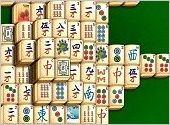
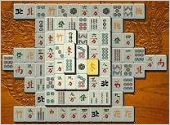
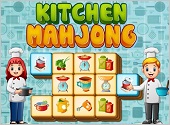
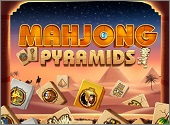
Classic mahjong solitaire (Alchemy, Butterfly, Candy, Christmas, Classic, Deluxe, Deluxe 2, EZ, Kitchen, Mahjong Story 2, Pirates, Pyramids, Xmas Mahjong). These all follow the standard format: tiles are stacked in a layered layout (pyramids, butterflies, castles, and other shapes), and you clear the board by matching pairs of free tiles.
The differences are in layout complexity, visual themes, and features like hints, shuffles, and timers. If you're new to mahjong solitaire, EZ Mahjong has a gentler learning curve. For a tougher challenge, Classic Mahjong or Deluxe Mahjong use denser layouts with more layers. Note: Classic, Deluxe, Kitchen, and Xmas Mahjong work best on desktop computers.
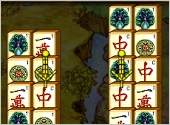
Mahjong Connect (Mahjong Connect, Mahjong Connect 2). These change the matching mechanic entirely. Instead of stacking tiles in layers, all tiles are laid flat in a grid, and you match pairs by drawing a connecting path between them. The path can turn up to two corners but can't pass through other tiles.
This shifts the cognitive demand from evaluating 3D layering to pathfinding: you need to visualize routes through a shifting grid, which exercises a different aspect of spatial reasoning. Connect games also run on a timer, adding time pressure to the visual search.
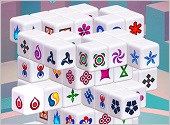
3D Mahjong (Dimensions Mahjong). This takes the classic tile-matching concept and wraps it around a rotating three-dimensional cube. You spin the cube to find matching tiles on different faces. This adds mental rotation, the ability to visualize objects from different angles, which is one of the most well-studied components of spatial intelligence. If you've gotten comfortable with flat-layout mahjong, the Dimensions variant adds a genuinely different cognitive challenge.
What the Research Shows
An important distinction: most published research on mahjong studies the traditional multiplayer game (four players competing with 136+ tiles), not the single-player solitaire version on this page. The multiplayer game adds social interaction, working memory demands (tracking opponents' discards), and strategic deception that the solitaire version doesn't have.
That said, the two formats share core cognitive demands: visual pattern recognition across many tiles, spatial awareness of tile positions, and strategic decision-making about which matches to pursue. The research on multiplayer mahjong provides a reasonable, if imperfect, window into the cognitive engagement these games offer.
A 2024 scoping review examined 53 studies on the relationship between mahjong and cognitive function in older adults. Across 47 observational studies, greater mahjong-playing experience was consistently associated with better cognitive, psychological, and functional abilities.
Six intervention studies (most using a 12-week protocol, three times per week) found that playing mahjong enhanced general cognitive abilities and short-term memory and reduced depressive symptoms. The reviewers noted that mahjong requires players to identify tiles, memorize opponents' moves, and predict future plays, engaging visual perception, memory, and strategic thinking simultaneously.[1]
One of the strongest individual studies, a randomized controlled trial, assigned 56 elderly adults with mild cognitive impairment to either a mahjong group or a control group. The mahjong group played three times a week for 12 weeks. After the intervention, the mahjong group showed significant improvements in executive function (measured by the MoCA-B) and in task-switching ability (measured by the Shape Trail Test), while the control group showed no change. The improvements appeared as early as 6 weeks and continued through week 12.[2]
Research on casual video games more broadly supports the idea that pattern-matching games exercise genuine cognitive abilities. A study of 209 participants found that color-matching and pattern-matching games (mechanics similar to mahjong solitaire's tile matching) were strongly associated with visuospatial abilities on standardized cognitive tests. This means performance on these games reflects real cognitive skills, not just game-specific practice.[3]
Getting the Most from Mahjong Solitaire
Plan before you match. The number-one mistake in mahjong solitaire is grabbing the first match you see. Before you click, scan the board for tiles that appear three or four times in visible positions. Matching pairs that open up new tiles underneath is more valuable than clearing tiles on the edges that aren't blocking anything. This deliberate approach exercises the planning component more than reactive matching does.
Work from the top down and from the center out. Tiles in the highest layers and the center of the layout are blocking the most other tiles. Freeing them creates the most new options. This simple principle forces you to evaluate the 3D structure of the layout rather than just scanning for the nearest match.
Try different formats for variety. If you always play classic solitaire, try the Connect versions for a different spatial challenge (pathfinding instead of layer evaluation). Dimensions Mahjong adds mental rotation, which is a largely separate spatial ability. Switching between formats keeps your brain from settling into autopilot.
Pair mahjong with other game types. Mahjong solitaire primarily trains visual-spatial processing and planning. For well-rounded cognitive engagement, pair it with word games (language processing), math games (numerical reasoning), or board games (strategic thinking). The Brain Games guide explains how different game types target different skills.
A Note on Mahjong's History
The original multiplayer mahjong game originated in China, with roots likely dating to the mid-to-late 1800s (despite popular claims of a 2,500-year history, historians place its development much more recently). The solitaire version you play here was popularized in 1981 when Brodie Lockard, a computer science student, created a computer adaptation called "Mah-Jongg" for the PLATO educational system.
That concept was later commercialized as "Shanghai" by Activision in 1986, bringing mahjong solitaire to a global audience. Today, it remains one of the most popular casual games in the world.
More Free Brain Games
Looking for other types? The full games directory has 200+ games organized by category, including board games, card & tile games, concentration games, math games, memory games, puzzles, word games, and time management games.
Published: 04/29/2010
Last Updated: 02/22/2026
Content on this page adheres to my editorial standards. See the medical disclaimer regarding health-related information.
References & Research
I've reviewed these sources and selected them for their relevance to understanding how mahjong-style games affect cognition. Here's what each contributes:
1. Tse, Z. C. K., et al. (2024). "Does Playing Mahjong Benefit Older Individuals? A Scoping Review." The Journal of Prevention of Alzheimer's Disease, 11(5), 1363-1377. Full text at PMC
Researcher's Note: This is the most comprehensive review of mahjong research to date. Researchers at the Hong Kong Polytechnic University systematically searched thirteen databases (both Western and Asian) and identified 53 studies on mahjong and cognitive function. The key finding: across observational studies, more mahjong experience was consistently associated with better cognitive, psychological, and functional abilities in older adults. Intervention studies showed improvements in general cognition and short-term memory. However, the reviewers are careful to note that most studies used correlational methods, meaning we can't fully separate cause from effect (people with better cognition may be more likely to play mahjong). They recommend more randomized controlled trials. Note: This review covers the multiplayer game, not solitaire. The shared cognitive demands (visual pattern recognition, spatial processing, strategic planning) apply to both formats, but the social and memory-tracking components of multiplayer mahjong are absent from the solitaire version.
2. Zhang, H., Peng, Y., Li, C., Lan, H., et al. (2020). "Playing Mahjong for 12 Weeks Improved Executive Function in Elderly People With Mild Cognitive Impairment." Frontiers in Neurology, 11, 178. Full text at PMC
Researcher's Note: This randomized controlled trial provides some of the strongest evidence for mahjong's cognitive benefits. Fifty-six elderly adults with mild cognitive impairment were randomly assigned to play mahjong three times weekly for 12 weeks or to continue normal daily activities. The mahjong group showed significant improvements in executive function (MoCA-B scores) and task-switching ability (Shape Trail Test) compared to controls. The improvements were measurable by week 6 and continued through week 12. The researchers used the MoCA-B rather than the more common MMSE, which matters because the MoCA-B is more sensitive to changes in executive function and visual-spatial abilities. Again, this studied the multiplayer game, but the executive function and task-switching improvements are relevant to the solitaire version, which requires similar planning and attention-shifting abilities.
3. Baniqued, P. L., Lee, H., Voss, M. W., Basak, C., Cosman, J. D., DeSouza, S., Severson, J., Salthouse, T. A., & Kramer, A. F. (2013). "Selling Points: What Cognitive Abilities Are Tapped by Casual Video Games?" Acta Psychologica, 142(1), 74-86. Full text at PMC
Researcher's Note: While this study didn't specifically test mahjong solitaire, it directly addresses the question of whether casual pattern-matching games exercise real cognitive abilities. Researchers at the University of Illinois had 209 participants play 20 different casual games and complete standardized cognitive tests. They found that pattern-matching and color-matching games (the same core mechanic as mahjong solitaire's tile pairing) were strongly associated with visuospatial abilities on standardized tests. This means performance on these games reflects genuine cognitive skills, not just game-specific practice. The study used rigorous structural equation modeling and was funded by the Office of Naval Research, lending it both methodological and institutional credibility.
Newest / Popular
Multiplayer
Board Games
Card & Tile
Concentration
Daily Games
Math / Memory
Puzzles
Time Mgmt
Word Games
- Retro Flash -
Also:
Bubble Pop
• Solitaire
• Tetris
Checkers
• Mahjong Tiles
•Typing
No sign-up or log-in needed. Just go to a game page and start playing! 

Sudoku, Kakuro, Word Searches, Crosswords, Slitherlink & more!
Hundreds of printable puzzles you can download, print, and solve with pencil and paper.

Hippocampus? Working memory? Spaced repetition?
Look up memory or brain terms in the A-Z glossary of definitions.