- Home
- Brain Games
- Free Online Brain Games
- Free Time Management Games
Free Time Management Games: Strategy Under Pressure
Time management games occupy a unique space among brain games. Concentration games test how fast you can react. Puzzle games test how well you can reason without time pressure. Time management games combine both: you have to figure out the right move and execute it before the clock runs out.
That makes them a particularly effective workout for the brain's executive functions, the planning, prioritizing, and task-switching skills that govern everyday decision-making. Pick one and play; no login needed. For all game categories, see the full games directory.
Note: If the games won't open, please: 1) turn off Adblock for this site, or 2) try with a different browser.


Why Time Pressure Changes the Cognitive Workout
Consider the difference between chess and a restaurant rush. In chess, you have as much time as you need to weigh your options. In a game like Penguin Diner, four customers arrive at once, each with different orders and different patience levels, and you have seconds to decide who to seat, who to serve, and what to cook first. The underlying cognitive skill is the same (prioritization), but adding time pressure changes the demands dramatically.
That pressure forces your brain to switch between tasks rapidly. Researchers call this "task switching," and it's one of the core components of executive function. When you're playing a restaurant game and simultaneously tracking customer orders, monitoring food timers, and calculating which table needs attention next, you're rapidly shifting between different task sets. Each switch has a small cognitive cost, and the faster you need to switch, the more your brain has to work to minimize those costs.
A 2008 study at the University of Illinois trained older adults with a real-time strategy game for 23.5 hours and measured changes across a battery of cognitive tests. The training group showed significant improvements in task switching, working memory, visual short-term memory, and reasoning compared to the control group. Notably, the more a participant improved at the game itself, the more they improved at task switching on a completely unrelated test.[1]
Three Types of Time Management Games
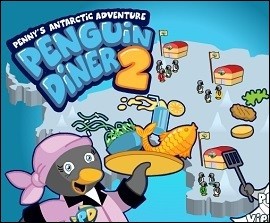
Restaurant games like Penguin Diner 2 force
rapid prioritization under deadline pressure
The games in this collection fall into three categories, each with a different cognitive profile.
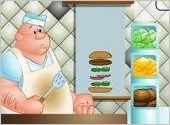
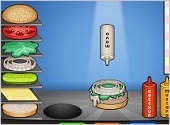
Restaurant and service games (Burger Builder, Burger Shop, Penguin Diner, Penguin Diner 2) are the purest time-management challenge. You're juggling multiple customer demands simultaneously, each on its own timeline. The cognitive load comes from holding several tasks in working memory at once while continuously re-prioritizing based on what's most urgent. These games get hard quickly because the number of simultaneous demands escalates faster than your ability to handle them, forcing you to develop more efficient strategies.
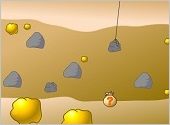
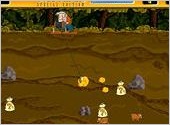
Resource and strategy games (Goodgame Big Farm, Goodgame Empire, Gold Miner, Gold Miner 2) add a longer planning horizon. Instead of moment-to-moment juggling, you're making decisions that play out over minutes or longer: where to invest resources, what to build next, how to balance short-term needs against long-term growth. This trains a different aspect of executive function. In the research literature, it's sometimes called "planning" or "prospective memory," the ability to hold a future goal in mind while executing current tasks.[1]
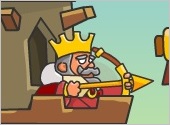
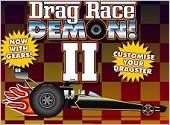
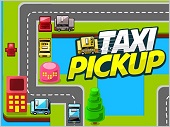
Tactical action games (Defend Your Castle, Drag Racer, Taxi Pickup) blend time management with rapid motor responses. You're making strategic decisions (where to deploy defenses, which route to take, when to upgrade) while also reacting in real time. This combination of planning and reflexes engages both the executive control network and the faster, more automatic processing systems that concentration games target.
What the Research Shows
The strongest evidence for cognitive benefits from time management-style games comes from research on real-time strategy (RTS) games, which share the same core demands: managing resources, switching between tasks, and making decisions under time pressure.
A 2013 study found that 40 hours of RTS game training (playing StarCraft) produced a large, selective improvement in cognitive flexibility, the ability to switch between different mental tasks and adapt to changing rules. Participants who played a version of the game requiring rapid switching between multiple bases and unit types showed the greatest gains. The control group, which played a life simulation game (The Sims) with no time pressure or multitasking demands, showed no improvement.[2]
This selective result is telling. It wasn't just "playing games" that helped. It was the specific combination of simultaneous task management under time pressure that produced the cognitive flexibility gains. A 2023 meta-analysis of 63 video game training studies confirmed this pattern: cognitive benefits depend more on specific gameplay features (time pressure, managing multiple objectives, resource allocation) than on whether a game is classified as "action," "strategy," or "casual."[3]
The time management games here share those features. A restaurant game with five customers and three cooking stations creates genuine multitasking demands. A farming game with limited gold and competing upgrade paths creates genuine resource-allocation pressure. These are simplified versions of the same cognitive challenges studied in the research, packaged in formats that are accessible and quick to pick up.
Getting the Most from These Games
A few principles from the research can help you get more from these games.
Embrace the difficulty spike. In nearly every time management game, there's a level where things suddenly feel overwhelming, too many customers, too few resources, too little time. That's the sweet spot. The cognitive benefits come from pushing past your current capacity, not from coasting through easy levels. When you fail and try again with a better strategy, that's executive function at work.
Pay attention to your strategy, not just your speed. It's tempting to just click faster, but these games reward planning more than reflexes. Before a level starts, think about what went wrong last time. Did you waste time on low-priority tasks? Did you forget about a customer? Deliberate strategy adjustment is what separates these games from pure reaction-time challenges.
Rotate across game types. The restaurant games, strategy builders, and tactical games each stress different cognitive skills. Playing all three types gives your brain a broader workout than sticking with one. For an even more complete brain-training routine, mix in games from other categories: board games for deep strategy, memory games for recall, word games for verbal processing. The Brain Games guide explains how to match game types to cognitive goals.
More Free Brain Games
Looking for other types? The full games directory has 200+ games organized by category, including board games, card & tile games, concentration games, math games, memory games, puzzles, and word games. If you prefer pencil-and-paper challenges, check out the printable puzzles section.
Published: 10/31/2013
Last Updated: 02/22/2026
Content on this page adheres to my editorial standards. See the medical disclaimer regarding health-related information.
References & Research
I've reviewed these sources and selected them for their relevance to understanding how time management games affect executive function. Here's what each contributes:
1. Basak, C., Boot, W. R., Voss, M. W., & Kramer, A. F. (2008). "Can Training in a Real-Time Strategy Videogame Attenuate Cognitive Decline in Older Adults?" Psychology and Aging, 23(4), 765-777. Full text at PMC
Researcher's Note: This is one of the most-cited studies on strategy game training and cognition. Older adults (average age 69) trained with Rise of Nations, a real-time strategy game that requires resource management, territory expansion, and multi-front decision-making, essentially the same cognitive demands as the time management games on this page. After 23.5 hours of training, they showed significant improvements in task switching, working memory (N-back), visual short-term memory, and reasoning. The key finding: individual improvements in game performance correlated with individual improvements in task switching, suggesting that the executive function gains were directly linked to the gameplay demands rather than some general "stimulation" effect.
2. Glass, B. D., Maddox, W. T., & Love, B. C. (2013). "Real-Time Strategy Game Training: Emergence of a Cognitive Flexibility Trait." PLoS ONE, 8(8), e70350. Full text at PMC
Researcher's Note: This study addressed a key question: does it matter how you play a strategy game? Participants who played StarCraft (which requires rapid switching between managing multiple bases, units, and threats simultaneously) showed large improvements in cognitive flexibility on non-game tasks. Those who played The Sims (which has no time pressure or multitasking) did not. Even within the StarCraft group, participants who played a more complex version with more simultaneous demands showed greater gains. This shows that the cognitive benefits come specifically from the combination of multitasking and time pressure, not just from "playing a strategy game."
3. Smith, E. T., & Basak, C. (2023). "A Game-Factors Approach to Cognitive Benefits from Video-Game Training: A Meta-Analysis." PLoS ONE, 18(8), e0285925. Full text at PMC
Researcher's Note: This meta-analysis of 63 studies (2,079 participants) moved the field beyond genre labels. Instead of asking "do strategy games help cognition?" it asked "which specific gameplay features predict cognitive benefits?" The answer: features like managing multiple objects simultaneously, time pressure, and resource allocation were better predictors of cognitive gains than whether a game was categorized as "action" or "strategy." This validates the approach of the time management games on this page, which share these exact features in accessible, quick-to-learn formats, even though they're simpler than the research-grade RTS games used in laboratory studies.
Newest / Popular
Multiplayer
Board Games
Card & Tile
Concentration
Daily Games
Math / Memory
Puzzles
Time Mgmt
Word Games
- Retro Flash -
Also:
Bubble Pop
• Solitaire
• Tetris
Checkers
• Mahjong Tiles
•Typing
No sign-up or log-in needed. Just go to a game page and start playing! 

Sudoku, Kakuro, Word Searches, Crosswords, Slitherlink & more!
Hundreds of printable puzzles you can download, print, and solve with pencil and paper.

Hippocampus? Working memory? Spaced repetition?
Look up memory or brain terms in the A-Z glossary of definitions.