- Home
- Brain Games
- Free Online Brain Games
- Free Online Solitaire Games
Free Online Solitaire Games
Solitaire looks like a game of luck, but the best players know otherwise. Every variant below presents you with the same core challenge: evaluate what's visible, plan a sequence of moves, and manage competing constraints (building sequences by color while sorting by suit, for instance) all at once. That's why researchers at KU Leuven found that how someone plays Klondike Solitaire reveals measurable differences in cognitive performance.
The 12 free solitaire games below range from mostly-luck to pure-strategy; pick one and play, no login needed. For all game categories, see the full games directory.




What Your Brain Does During Solitaire
Every solitaire game requires you to manage at least three cognitive tasks simultaneously. The first is sequential planning: figuring out the right order to move cards so that each move opens up future options rather than creating dead ends. This is especially demanding in games like FreeCell, where all 52 cards are visible from the start and every game is theoretically winnable if you plan correctly.
The second task is constraint management. In Klondike, for example, you're building descending sequences that alternate colors on the tableau while simultaneously building ascending same-suit sequences on the foundations.
These two goals often conflict: the card you need to continue a tableau sequence might be better placed on a foundation. Deciding which goal to prioritize on a given move requires holding multiple rules in working memory at once.
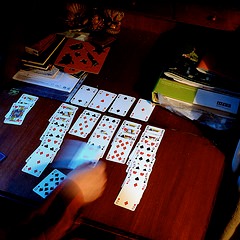
The third task is tracking hidden information. In Klondike-style games, you don't know what's under the face-down cards or what's coming from the draw pile. You have to make decisions under uncertainty, sometimes taking a calculated risk on an unknown card. In open-information games like FreeCell, this uncertainty disappears entirely, and the challenge shifts to pure planning depth.
This combination of planning, rule management, and decision-making under uncertainty is why researchers have identified solitaire as a useful window into cognitive function. It's not that solitaire is uniquely therapeutic; it's that the way you play reflects how well your executive functions are working.
Choosing a Game by Type
Build-and-sort (Klondike-style). Basic Solitaire, Classic Solitaire, Klondike Solitaire, Solitaire Story. These follow the format most people know: deal cards into a tableau, turn cards from a draw pile, and build ascending suit sequences on foundations.
Luck plays a moderate role (you can't control the deal or the draw), but skilled players win significantly more often than beginners because they plan moves ahead and manage tableau columns strategically. If you're new to solitaire, start here. Solitaire Story adds themed levels and progressive challenges for variety.
Open-information (pure strategy). Freecell Solitaire, Forty Thieves. In FreeCell, all 52 cards are dealt face-up, so there are no surprises. Nearly every deal is solvable with the right sequence of moves. This removes luck almost entirely and puts all the demand on sequential planning: you need to think several moves ahead and use the four free cells as temporary storage to maneuver cards into position.
Forty Thieves uses two decks (104 cards) with strict rules that demand even longer planning chains. These are the most cognitively demanding variants on this page.
Elimination (matching and sequencing). Pyramid Solitaire, Golf Solitaire, Tripeaks Solitaire. Instead of building sorted sequences, you remove cards by pairing them to a target sum (Pyramid: pairs that add up to 13) or by matching ascending/descending sequences (Golf, Tripeaks).
These games are faster-paced and emphasize rapid scanning and numerical reasoning over deep planning. Tripeaks adds a timer element, which makes it a decent test of quick visual search and decision speed.
Multi-deck and complex layouts. Algerian Solitaire, Crescent Solitaire, Spider Solitaire. These use double decks, unusual layouts, or more complicated rules. Spider Solitaire, one of the most popular variants worldwide, deals cards in ten columns with multiple suits and requires you to build complete descending sequences before they can be removed.
Crescent uses a circular layout with specific rules about which cards can move where. These variants demand stronger working memory (more cards and rules to track) and longer planning horizons than the Klondike-style games.
What the Research Shows
Researchers at KU Leuven (Belgium) ran a study that demonstrates just how much cognitive information is embedded in solitaire gameplay. They had 23 healthy older adults and 23 older adults with mild cognitive impairment (MCI) each play three rounds of Klondike Solitaire. Using machine learning models trained on 23 digital biomarkers (metrics like move speed, error rate, hint usage, and planning pauses), the researchers could distinguish between the two groups with over 81% accuracy.
That accuracy is comparable to standard cognitive screening tests used in clinical settings. The researchers specifically noted that lapses in attention or executive functioning cause important moves to be overlooked, making the game unsolvable.[1]
A companion study by the same team went deeper, having 11 cognitive impairment experts map 21 Klondike Solitaire player actions to 11 cognitive functions. Every player action was rated as moderately to strongly correlated with at least one cognitive function.
The actions most sensitive to cognitive differences involved planning moves, managing the free cells and draw pile, and error rates. The researchers concluded that commercial card games show genuine potential as tools for cognitive monitoring.[2]
On a broader level, a 20-year French population study (the Paquid cohort) found that older adults who regularly played board and card games had a 15% lower risk of developing dementia compared to non-players. The association persisted even after controlling for education, social activity, and physical activity. The researchers noted that the benefit appeared to work through two pathways: slower cognitive decline and reduced depressive symptoms.[3]
Getting the Most from Solitaire
Play deliberately, not on autopilot. The KU Leuven research found that the biggest cognitive differences between groups showed up in planning-related metrics, not in speed. Rushing through moves without thinking ahead reduces solitaire to a reflex task. Before each move, consider what it will open up and what it might block.
Graduate to harder variants. If you can win Klondike regularly, try FreeCell (pure planning, no luck) or Spider Solitaire (longer sequences, more cards to track). The shift from partial-information games to open-information games changes the cognitive demand from managing uncertainty to managing complexity.
Notice your decision patterns. Do you always draw from the stock pile first, or do you scan the tableau first? Do you move cards to foundations immediately, or hold them on the tableau for flexibility? Becoming aware of your strategy (rather than playing by habit) keeps the cognitive engagement higher.
Mix in other game types. Solitaire primarily exercises sequential planning and constraint management. For a broader workout, pair it with mahjong tile games (visual-spatial processing), word games (language retrieval), or puzzle games (logical reasoning). The Brain Games guide explains how different categories target different cognitive skills.
More Free Brain Games
Looking for other types? The full games directory has 200+ games organized by category, including board games, card & tile games, concentration games, math games, memory games, mahjong, word games, and time management games.
Published: 07/10/2011
Last Updated: 02/22/2026
Content on this page adheres to my editorial standards. See the medical disclaimer regarding health-related information.
References & Research
I've reviewed these sources and selected them for their relevance to understanding how solitaire card games relate to cognitive function. Here's what each contributes:
1. Gielis, K., Vanden Abeele, M.-E., Verbert, K., Tournoy, J., De Vos, M., & Vanden Abeele, V. (2021). "Detecting Mild Cognitive Impairment via Digital Biomarkers of Cognitive Performance Found in Klondike Solitaire: A Machine-Learning Study." Digital Biomarkers, 5(1), 44-52. Full text at PMC
Researcher's Note: This is one of the few studies that directly examines solitaire as a cognitive assessment tool. KU Leuven researchers captured gameplay data from 46 older adults (half healthy, half with clinically diagnosed mild cognitive impairment) playing Klondike Solitaire on tablets. They trained machine-learning models on 23 digital biomarkers derived from gameplay and achieved classification accuracy comparable to standard cognitive screening tests (F1 scores above 0.81, AUC above 0.87). The key finding: cognitive differences show up in how people play solitaire, not just in whether they win. Planning pauses, error rates, hint usage, and move patterns all carry measurable cognitive information. This is directly relevant because it confirms that solitaire gameplay engages real cognitive abilities, not just game-specific skills.
2. Gielis, K., Vanden Abeele, M.-E., De Croon, R., Dierick, P., Ferreira-Brito, F., Van Assche, L., Verbert, K., Tournoy, J., & Vanden Abeele, V. (2021). "Dissecting Digital Card Games to Yield Digital Biomarkers for the Assessment of Mild Cognitive Impairment: Methodological Approach and Exploratory Study." JMIR Serious Games, 9(4), e18359. Full text at PMC
Researcher's Note: This companion study is especially valuable because it maps specific solitaire player actions to specific cognitive functions. Eleven experts in cognitive impairment were asked to evaluate 21 Klondike Solitaire player actions, and expert agreement was strong (intraclass correlations above 0.75). They identified connections to executive function, attention, visuospatial processing, problem solving, and working memory. In the subsequent study of 46 older adults, 12 of 23 tested digital biomarkers showed significant differences between healthy and MCI groups. The researchers explicitly noted that a lapse in attention or executive functioning during play can cause important moves to be overlooked, making the game unsolvable. This provides the clearest published evidence that solitaire engages multiple cognitive domains simultaneously.
3. Dartigues, J. F., Foubert-Samier, A., Le Goff, M., Viltard, M., Amieva, H., Orgogozo, J. M., Barberger-Gateau, P., & Helmer, C. (2013). "Playing Board Games, Cognitive Decline and Dementia: A French Population-Based Cohort Study." BMJ Open, 3(8), e002998. Full text at PMC
Researcher's Note: This is one of the longest population studies on games and dementia risk. The Paquid cohort followed over 3,675 older French adults for 20 years. Board and card game players had a 15% lower risk of developing dementia compared to non-players. The study is notable for its duration (most similar studies follow participants for 5-7 years) and its careful statistical controls. The researchers found that the relationship between game-playing and lower dementia risk appeared to work through two mechanisms: slower cognitive decline and fewer depressive symptoms. An important caveat: the study can't definitively prove that game-playing prevents dementia (it's possible that people with better cognitive health are simply more likely to play games), but the 20-year follow-up period makes reverse causation less likely.
Newest / Popular
Multiplayer
Board Games
Card & Tile
Concentration
Daily Games
Math / Memory
Puzzles
Time Mgmt
Word Games
- Retro Flash -
Also:
Bubble Pop
• Solitaire
• Tetris
Checkers
• Mahjong Tiles
•Typing
No sign-up or log-in needed. Just go to a game page and start playing! 

Sudoku, Kakuro, Word Searches, Crosswords, Slitherlink & more!
Hundreds of printable puzzles you can download, print, and solve with pencil and paper.

Hippocampus? Working memory? Spaced repetition?
Look up memory or brain terms in the A-Z glossary of definitions.