- Home
- Brain Games
- Free Online Brain Games
- Free Sudoku Games
Free Sudoku Games: Play Online & Printable
Sudoku is a constraint-satisfaction problem disguised as a number puzzle. Every time you place a digit, your brain is simultaneously checking three rules (no repeats in the row, column, or 3×3 box) while holding a mental map of what's still possible elsewhere on the grid. That triple-constraint checking is why brain imaging studies show Sudoku activates the prefrontal cortex more strongly than other common leisure activities like reading or watching TV.
Pick one of the three online versions below, or download printable puzzles to solve on paper. No login needed. For all game categories, see the full games directory.
What Your Brain Does During Sudoku
Sudoku looks like a number game, but it's really a logic puzzle. You never add, subtract, or calculate anything. Instead, you're doing something more cognitively interesting: managing a grid of overlapping constraints.
Every empty cell starts with nine possibilities (digits 1 through 9). Each placement you make eliminates possibilities from the cells that share its row, column, and box. Your job is to find cells where the constraints leave only one option, or to chain together deductions that reveal the answer indirectly. This process, called constraint propagation, is a fundamental problem-solving strategy that shows up everywhere from scheduling to circuit design.
What makes Sudoku a strong cognitive exercise is the working memory load. To solve a cell, you need to hold the current state of its row, column, and box in mind simultaneously while scanning for conflicts. On harder puzzles, you may need to consider hypothetical placements ("if this cell is a 5, then that cell can't be a 5, which means...") that require you to maintain and manipulate multiple possibilities at once.
Researchers at an Indian medical university used functional near-infrared spectroscopy (fNIRS) to measure brain activity during Sudoku and found that both medial and lateral regions of the prefrontal cortex were activated, with the medial regions playing a particularly important role when solvers needed to search for and select among different solving strategies.[1]
The Three Online Games
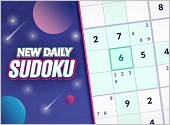
Daily Sudoku delivers a new puzzle every day across multiple difficulty levels. Good for building a daily habit since you get one fresh puzzle per difficulty per day, which prevents the temptation to binge-solve and then lose the routine.
Sudoku Royal offers unlimited puzzles with a clean interface and multiple difficulty settings. A solid choice if you want to solve several puzzles in a sitting or work on a specific difficulty level consistently.
Ultimate Sudoku (247 Sudoku) has the most features of the three, including a pencil marks/notes mode that lets you annotate cells with candidate numbers, similar to pencil marks on paper. It also offers Easy, Medium, Hard, and Expert levels. If you're working on advanced techniques like X-Wings or hidden pairs, the notes feature makes this the best online option here for serious practice.
Printable Sudoku & Solving Guides
Prefer solving on paper? I've created 100 free printable Sudoku puzzles sorted by difficulty from Easy to Very Hard, with solutions included. Each puzzle is a single-page PDF designed for comfortable paper solving with room for pencil marks.
Paper solving has a practical advantage for harder puzzles: it's easier to write candidate numbers, draw elimination marks, and track complex deduction chains in the margins than it is on a screen. Many experienced solvers prefer paper for anything above Medium difficulty for exactly this reason.
If you're new to Sudoku or want to learn more advanced techniques, I've written step-by-step solving guides that walk through actual puzzles at three difficulty levels: Easy (naked singles, hidden singles), Medium (pointing pairs, box/line reduction), and Hard (X-Wings, swordfish, and other advanced patterns).
What the Research Shows
A brain imaging study used functional near-infrared spectroscopy to measure prefrontal cortex activity while participants solved Sudoku puzzles. The researchers divided the task into two steps: one requiring basic number placement within a single box, and another requiring coordination across rows, columns, and boxes simultaneously.
Both steps activated the prefrontal cortex, but the multi-constraint step produced significantly greater activation in the medial prefrontal region, the area responsible for selecting and coordinating complex problem-solving strategies. The researchers concluded that Sudoku engages genuine executive function processes, not just pattern matching.[1]
An international study using data from 17,000+ European adults aged 65 and older (the SHARE survey) tracked participants over two years and compared those who regularly engaged in number or word puzzles with those who didn't. Puzzle players showed significantly better memory, numeracy, and verbal fluency scores after two years, even after controlling for education, health, financial status, and social network.
Notably, the benefit was strongest among people with less formal education. People who started doing puzzles between the two survey waves showed better cognitive function than those who never started, suggesting it's never too late to begin.[2]
The largest study to date on number puzzles and cognition, the PROTECT study, evaluated 19,078 adults aged 50 to 93. Participants who regularly did number puzzles like Sudoku performed significantly better on all 14 cognitive measures tested, including reasoning, focused and sustained attention, information processing, executive function, working memory, and episodic memory. Those who solved puzzles more than once daily showed the strongest performance, though even occasional solvers outperformed non-solvers.[3]
Getting the Most from Sudoku
Learn the techniques, not just the game. Many people solve Easy puzzles by trial and error (guessing a number and seeing if it works). This approach hits a wall at Medium difficulty and teaches your brain very little. Learning actual solving techniques like naked singles, hidden pairs, and pointing pairs turns Sudoku from a guessing game into a deduction chain, which is where the cognitive benefit lives. The solving guides on this site walk through these methods step by step.
Increase difficulty gradually. The research shows that cognitive benefits come from sustained challenge, not from solving puzzles that are too easy. If you can finish an Easy puzzle in under 5 minutes without getting stuck, move up to Medium. If Medium feels routine, try Hard. The goal is to stay in the zone where you need to think deliberately rather than solve on autopilot.
Use pencil marks on harder puzzles. Writing candidate numbers in cells isn't cheating; it's how experienced solvers manage working memory on complex grids. Trying to hold all the possibilities in your head sounds impressive but usually just leads to errors. The mental workout comes from the deduction process, not from the memory overload.
Try related number puzzles for variety. If you enjoy Sudoku, you'll likely enjoy Kakuro (Sudoku meets crossword arithmetic), KenKen (Sudoku meets basic math operations), or Futoshiki (Sudoku meets inequality constraints). Each one exercises the same constraint-satisfaction logic in a different way, which keeps your brain from settling into familiar patterns.
More Free Brain Games
Looking for other types? The full games directory has 200+ games organized by category, including math games, puzzle games, word games, board games, concentration games, memory games, and mahjong.
Published: 04/29/2010
Last Updated: 03/10/2026
Content on this page adheres to my editorial standards. See the medical disclaimer regarding health-related information.
References & Research
I've reviewed these sources and selected them for their relevance to understanding how Sudoku and similar number puzzles relate to cognitive function. Here's what each contributes:
1. Ashlesh, P., Deepa, N., & Mishra, S. (2020). "Role of Prefrontal Cortex During Sudoku Task: fNIRS Study." Translational Neuroscience, 11(1), 419-427. Full text at PMC
Researcher's Note: This is one of the few studies that directly measured brain activity during Sudoku solving using functional near-infrared spectroscopy (fNIRS). The researchers cleverly divided the Sudoku task into two steps: one requiring placement within a single 3×3 box (simpler constraint), and another requiring coordination across rows, columns, and boxes simultaneously (multiple constraints). Both steps activated the prefrontal cortex, but the multi-constraint step produced significantly more activation in the medial prefrontal region, which is associated with strategy selection and cognitive control. This matters because it demonstrates that Sudoku engages genuine executive function, not just visual scanning or pattern matching. The study was conducted at a medical university in India and is particularly useful for understanding the neural basis of why Sudoku feels mentally demanding.
2. Litwin, H., & Schwartz, E. (2018). "Cognitively Stimulating Leisure Activity and Subsequent Cognitive Function: A SHARE-based Analysis." The International Journal of Aging and Human Development, 88(4), 382-400. Full text at PMC
Researcher's Note: This study stands out for its scale and longitudinal design. Researchers at the Hebrew University of Jerusalem analyzed data from over 17,000 European adults aged 65+ across two waves of the SHARE survey (2010 and 2012/2013). They measured three cognitive domains (memory, numeracy, and verbal fluency) and tracked whether puzzle-playing predicted changes over time. The results were positive across all three domains, with two particularly interesting findings. First, the cognitive benefit of number and word puzzles was strongest among people with less formal education, suggesting that puzzles may help compensate for lower baseline cognitive stimulation. Second, people who started playing puzzles between the two survey waves improved compared to non-starters, which addresses the "reverse causation" concern (the worry that smarter people simply play more puzzles rather than puzzles making people smarter). The researchers controlled for health, finances, and social networks, making this one of the more methodologically careful population studies on the topic.
3. Brooker, H., Wesnes, K. A., Ballard, C., Hampshire, A., Aarsland, D., Khan, Z., Stenton, R., Megalogeni, M., & Corbett, A. (2019). "The Relationship Between the Frequency of Number-Puzzle Use and Baseline Cognitive Function in a Large Online Sample of Adults Aged 50 and Over." International Journal of Geriatric Psychiatry, 34(7), 932-940. View at PubMed
Researcher's Note: The PROTECT study is the largest investigation of number puzzles and cognitive function to date. With 19,078 participants aged 50 to 93, it has the statistical power to detect effects that smaller studies might miss. Participants self-reported how often they did number puzzles (including Sudoku), and completed two separate cognitive test batteries covering reasoning, attention, information processing, executive function, working memory, and episodic memory (14 measures total). More frequent puzzle use was associated with significantly better performance on all 14 measures (all P values below 0.0004). The dose-response pattern is notable: people who solved puzzles more than once daily performed best, though even occasional solvers outperformed those who never solved. This study is cross-sectional (one time point), so it can't prove that puzzles caused the better performance, but the consistency across all 14 cognitive measures and the dose-response relationship are strongly suggestive. The study was published in a peer-reviewed geriatric psychiatry journal and funded by the UK's Alzheimer's Society.
Newest / Popular
Multiplayer
Board Games
Card & Tile
Concentration
Daily Games
Math / Memory
Puzzles
Time Mgmt
Word Games
- Retro Flash -
Also:
Bubble Pop
• Solitaire
• Tetris
Checkers
• Mahjong Tiles
•Typing
No sign-up or log-in needed. Just go to a game page and start playing! 

Sudoku, Kakuro, Word Searches, Crosswords, Slitherlink & more!
Hundreds of printable puzzles you can download, print, and solve with pencil and paper.

Hippocampus? Working memory? Spaced repetition?
Look up memory or brain terms in the A-Z glossary of definitions.