- Home
- Brain Games
- Free Online Brain Games
- Fun Typing Games
Fun Typing Games: Speed & Accuracy Training
Typing games give you something most brain games don't: two precise numbers after every session. Your words-per-minute tells you how fast your brain processes and executes. Your error rate tells you how accurately it does so. That combination, processing speed measured alongside accuracy, is exactly what cognitive scientists look for when assessing mental sharpness.
Pick a game below and play; no login needed. For all game types, see the full games directory.
Note: If the games won't open, please: 1) turn off Adblock for this site, or 2) try with a different browser.
What Typing Actually Demands from Your Brain
Typing looks simple from the outside: see a letter, press a key. But brain imaging tells a different story. An fMRI study of skilled typists found that typing activates a network of brain regions, including the left superior parietal lobule, the supramarginal gyrus, and the premotor cortex near Exner's area (a region associated with written language production).
Notably, typing activated the left posteromedial intraparietal cortex more strongly than handwriting did, suggesting that the brain treats typing as a distinct cognitive-motor skill, not just a simpler version of writing.[1]
That makes sense when you break down what actually happens during a typing game. Your brain runs three processes in rapid sequence: (1) visually read the letter or word, (2) translate that visual input into a motor plan (which fingers, which keys, in what order), and (3) execute the finger movements.
In a typing game, all three steps happen under time pressure, with new stimuli arriving before you've finished the last one. Your brain is reading ahead while your fingers are still catching up.
This is why typing games feel so engaging. They push the limits of how fast your brain can cycle through see-plan-move, over and over, while maintaining accuracy.
The Speed-Accuracy Tradeoff
Every typing game forces you to confront one of the most fundamental challenges in human cognition: the speed-accuracy tradeoff. Go faster, and you make more mistakes. Slow down for accuracy, and you run out of time.
Researchers have studied this tradeoff extensively, and it turns out to be one of the most universal properties of decision-making, appearing in everything from eye movements to complex reasoning tasks.[2]
What makes typing games a particularly effective way to train this tradeoff is that the feedback is immediate and unambiguous. You either typed the right letter or you didn't. The game speeds up or you fall behind. There's no room for vague self-assessment.
That kind of precise, real-time feedback is exactly what drives neuroplasticity, your brain's ability to reorganize itself in response to practice.
A large randomized controlled trial (681 adults, ages 50 and older) found that just 10 hours of speed-of-processing training produced significant improvements in cognitive processing speed that lasted at least one year. The training involved rapidly identifying and responding to visual stimuli under increasing time pressure, which is essentially what typing games do.[3]
The Six Games
All six games follow the same core loop (characters or words appear, you type them before time runs out), but each varies the format enough to keep the challenge fresh.
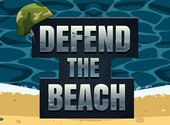
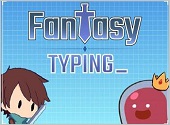
Defend the Beach drops falling letters that you type to destroy before they land. The visual metaphor makes it immediately clear when you're falling behind, which is useful feedback for beginners. Fantasy Typing uses full words instead of single characters, with fantasy creatures that you defeat by typing their associated word. Longer words and escalating speed add progressive challenge as you advance through levels.
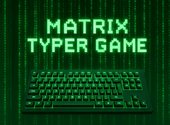
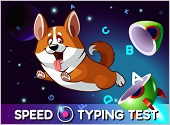
Matrix Typer rains single characters down the screen in a Matrix-style green cascade. The focus on individual keystrokes rather than whole words makes it a good drill for building finger-to-key associations, especially if you're learning touch typing. Speed Typing Test is the least "game-like" of the six: it's a straightforward words-per-minute benchmark. Less entertaining, but useful for tracking your progress over time.
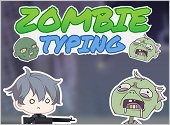
Type Run has you typing words to make your character sprint forward. The competitive pacing (you can see how far you've gotten) adds a sense of urgency that pure typing tests lack. Zombie Typing sends waves of zombies that you stop by typing the words above their heads. The escalating wave difficulty provides natural adaptive challenge, getting harder as you demonstrate you can handle it.
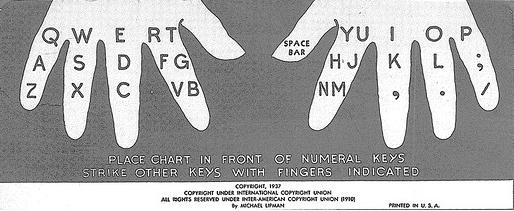
Keyboard finger chart from 1937 (image: Flickr / mpclemens).
The layout hasn't changed.
Touch Typing: The Skill Behind the Game
The single biggest factor in typing speed is whether you use touch typing, a method where muscle memory guides your fingers to each key without looking at the keyboard. Touch typists keep their fingers on the "home row" (A-S-D-F for the left hand, J-K-L-; for the right) and reach out to other keys from there. The 1937 keyboard chart above shows the same finger assignments used today.
Three habits will accelerate your progress with these games:
Don't look at the keyboard. This is the hardest habit to build and the most important. When you peek, you let your eyes do work that your fingers need to learn. Every time you force your hands to find the right key without visual help, you're strengthening the neural connections between your motor cortex and your finger movements.
It will feel slow and frustrating at first. That frustration is the feeling of your brain building new pathways.
Use proper hand position. Keep your feet flat, forearms parallel to the desktop, and eyes on the screen. Good posture reduces fatigue and errors, especially in longer sessions. Your eyes should follow the line of text with minimal head movement.
Practice consistently, not just occasionally. Motor skill learning follows a well-documented pattern: rapid initial improvement followed by slower, steady gains. Short, focused sessions (15 to 20 minutes) practiced regularly will build speed faster than occasional marathon sessions.
Getting More from Typing Games
These games all follow a similar format: letters or words appear on screen, and you type them as quickly and accurately as possible. As you improve, the game speeds up. A few tips for making the most of them:
Focus on accuracy first, then build speed. It's tempting to rush, but fast-and-sloppy typing reinforces bad habits. Aim for zero errors at a comfortable pace, then gradually push for speed. Your brain will adjust the speed-accuracy balance naturally as the motor patterns solidify.
Try to read ahead. In falling-letter games, look at the next letter while your fingers are still pressing the current one. This trains the "pipeline" of see-plan-move to overlap rather than run sequentially, which is how expert typists actually operate.
These games are part of the larger Concentration Games collection, which also includes breakout, pinball, bubble shooters, and other games that train processing speed and attention through different gameplay features. Typing games are unique in that collection because they produce measurable skill gains that transfer directly to everyday computer use.
More Free Brain Games
Looking for other types? The full games directory has 200+ games organized by category, including board games, card & tile games, puzzles, memory games, math games, and word games. If you prefer pencil-and-paper challenges, check out the printable puzzles section.
Published: 10/31/2010
Last Updated: 02/21/2026
Content on this page adheres to my editorial standards. See the medical disclaimer regarding health-related information.
References & Research
I've reviewed these sources and selected them for their relevance to understanding how typing engages the brain and why speed-of-processing training works. Here's what each contributes:
1. Higashiyama, Y., Takeda, K., Someya, Y., Kuroiwa, Y., & Tanaka, F. (2015). "The Neural Basis of Typewriting: A Functional MRI Study." PLoS ONE, 10(7), e0134131. Full text at PMC
Researcher's Note: This is the only fMRI study I'm aware of that directly compared brain activation during typing versus handwriting in the same participants. Sixteen skilled touch typists performed both tasks inside an MRI scanner. The finding that typing uniquely activates the left posteromedial intraparietal cortex (a region involved in transforming visual coordinates into motor programs) confirms that typing is a distinct cognitive-motor skill. This matters because it shows typing games are training a specific brain network, not just "pressing buttons faster."
2. Heitz, R. P. (2014). "The speed-accuracy tradeoff: history, physiology, methodology, and behavior." Frontiers in Neuroscience, 8, 150. Full text at PMC
Researcher's Note: This comprehensive review covers more than a century of research on the speed-accuracy tradeoff. The key insight for typing games: the tradeoff between going fast and staying accurate is not just a strategic choice. It reflects fundamental properties of how the brain accumulates evidence before making decisions. Typing games put you directly on this curve and force your brain to optimize it through practice. The paper also notes that the tradeoff appears across virtually all decision-making tasks, from simple reaction time to complex reasoning, which is why improving it through typing may have broader cognitive benefits.
3. Wolinsky, F. D., Vander Weg, M. W., Howren, M. B., Jones, M. P., & Dotson, M. M. (2013). "A Randomized Controlled Trial of Cognitive Training Using a Visual Speed of Processing Intervention in Middle Aged and Older Adults." PLoS ONE, 8(5), e61624. Full text at PMC
Researcher's Note: This large RCT (681 participants, ages 50 and older) is part of the broader ACTIVE study program, the most extensive research effort on cognitive training in older adults. Participants received 10 hours of speed-of-processing training that required rapidly identifying visual targets under increasing time pressure. The training group showed significant improvements in processing speed at one-year follow-up compared to an active control group that did crossword puzzles. This study matters because typing games involve the same core task, rapidly processing visual information and responding accurately under time pressure, and the ACTIVE program has shown these gains can persist for years.
Newest / Popular
Multiplayer
Board Games
Card & Tile
Concentration
Daily Games
Math / Memory
Puzzles
Time Mgmt
Word Games
- Retro Flash -
Also:
Bubble Pop
• Solitaire
• Tetris
Checkers
• Mahjong Tiles
•Typing
No sign-up or log-in needed. Just go to a game page and start playing! 

Sudoku, Kakuro, Word Searches, Crosswords, Slitherlink & more!
Hundreds of printable puzzles you can download, print, and solve with pencil and paper.

Hippocampus? Working memory? Spaced repetition?
Look up memory or brain terms in the A-Z glossary of definitions.