- Home
- Brain Games
- Free Online Brain Games
- Free Puzzle Games
Free Puzzle Games: Spatial, Logic & Pattern Training
This is the largest game category on the site, and for good reason. "Puzzle game" covers an enormous range of cognitive demands, from the spatial rotation required by Tetris to the logical deduction of Minesweeper to the pattern scanning of Bejeweled. That variety is actually an advantage: research shows that training across diverse cognitive tasks produces broader benefits than repeating a single type of exercise.[3]
Browse the full collection below, or jump to the guide underneath to understand what each type of puzzle actually trains. For all game categories, see the full games directory.
Note: If the games won't open, please: 1) turn off Adblock for this site, or 2) try with a different browser.










Not All Puzzles Train the Same Skills
Calling something a "puzzle game" is a bit like calling something "exercise." A Tetris game and a Minesweeper game are both puzzles, but they demand fundamentally different things from your brain. Understanding those differences helps you choose games that target the skills you want to develop.
Spatial and block puzzles
The Tetris variants, jigsaw puzzles, Rubik's Cube, and sliding puzzles all demand spatial reasoning: mentally rotating shapes, predicting how pieces fit together, and visualizing transformations before executing them. Tetris is one of the most studied games in cognitive science.
Research has found that Tetris performance is selectively associated with visuospatial working memory (the ability to hold and manipulate visual-spatial information) but not with verbal reasoning or other cognitive measures. The game specifically loads the part of your brain that handles spatial representation.[1]
Jigsaw puzzles engage an even broader set of abilities. A study of 100 adults aged 50 and over found that jigsaw puzzle skill was strongly associated with eight distinct visuospatial cognitive abilities: perception, constructional praxis, mental rotation, processing speed, flexibility, working memory, reasoning, and episodic memory.
Lifetime jigsaw puzzle experience was also associated with better global visuospatial cognition, even after accounting for age, education, and other activities.[2]
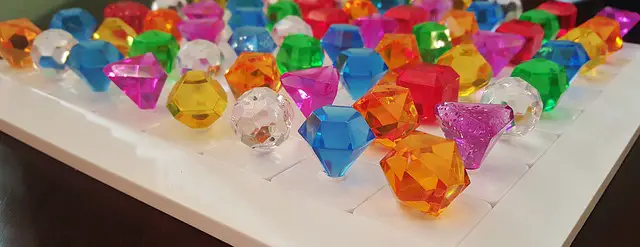
Different puzzle types exercise different cognitive skills
Logic and deduction puzzles
Minesweeper, Lights Out, Sokoban, and Tower of Hanoi are logic puzzles. They require you to apply rules systematically, deduce hidden information from available clues, and plan sequences of moves. These games exercise executive function, the brain's control system for planning, organizing, and reasoning through problems step by step. Where spatial puzzles ask "how does this fit?", logic puzzles ask "what must be true?"
If you enjoy this type of challenge, the printable puzzles section includes Sudoku, Kakuro, Slitherlink, and Futoshiki, all of which are pure logic puzzles you can solve with a pencil.
Match-3 and pattern games
Bejeweled, Candy Crush, Jewel games, and Garden Tales require rapid visual scanning: spotting matching patterns within a cluttered field, often under time pressure. The core skill here is selective visual attention, quickly identifying relevant information while ignoring distractions.
These games also exercise the speed-accuracy tradeoff, since you're constantly balancing the urge to move fast against the need to find the best possible match.[3]
Adventure and physics puzzles
Snail Bob, Cargo Bridge, Fireboy & Watergirl, Bob the Robber, and the Vex games combine puzzle-solving with action elements. They require you to plan a solution, then execute it with timing and coordination. The cognitive demands here blend problem-solving with motor control and split-second decision-making, which is a different kind of mental workout than sitting with a Minesweeper grid.
Getting the Most from Puzzle Games
The research on puzzle-based cognitive training points to three consistent findings that can guide how you play:
Difficulty matters more than time. The Fissler jigsaw study found that participants were encouraged to increase puzzle difficulty (more pieces) as they improved, and the researchers noted that challenge level was important for cognitive engagement.[2]
A puzzle that's too easy provides entertainment but minimal cognitive benefit. If you're breezing through Tetris at level 3, push to level 5. If Minesweeper's beginner grid is automatic, move to intermediate.
Variety produces broader benefits. A meta-analysis of 63 game-training studies found that specific gameplay features, not genre labels, predict which cognitive abilities improve. Playing several different puzzle types (spatial, logic, and pattern games) engages different neural systems, which means the benefits are more likely to transfer beyond the games themselves.[3]
Long-term engagement beats short bursts. The jigsaw study found that lifetime puzzle experience was associated with better visuospatial cognition, but a 30-day intervention alone showed limited effects.[2] This is consistent with the broader cognitive training literature: building cognitive reserve is a long-term process, not a quick fix. Consistent play over months and years is what accumulates benefits.
More Free Brain Games
Looking for other types? The full games directory has 200+ games organized by category, including board games, card & tile games, concentration games, math games, memory games, and word games. For pencil-and-paper challenges, see the printable puzzles. And for more on how brain games fit into a broader memory improvement strategy, visit the Brain Games guide.
Published: 10/04/2013
Last Updated: 02/22/2026
Content on this page adheres to my editorial standards. See the medical disclaimer regarding health-related information.
References & Research
I've reviewed these sources and selected them for their direct relevance to understanding how puzzle games affect cognition. Here's what each contributes:
1. Lau-Zhu, A., Holmes, E. A., Butterfield, S., & Holmes, J. (2017). "Selective Association Between Tetris Game Play and Visuospatial Working Memory: A Preliminary Investigation." Applied Cognitive Psychology, 31(4), 438–445. Full text at PMC
Researcher's Note: This study tested 46 young adults on six cognitive measures (verbal and non-verbal reasoning, verbal and visuospatial short-term memory, verbal and visuospatial working memory) and correlated them with Tetris performance. The key finding: Tetris scores were significantly associated with visuospatial working memory but showed no relationship with any other cognitive measure. That selectivity is what makes Tetris interesting. It doesn't train "everything." It specifically loads the spatial component of working memory, the system you use to mentally rotate objects, hold a mental map, and visualize spatial transformations. This tells us something important: different puzzle types really do train different things.
2. Fissler, P., Küster, O. C., Laptinskaya, D., Loy, L. S., von Arnim, C. A. F., & Kolassa, I.-T. (2018). "Jigsaw Puzzling Taps Multiple Cognitive Abilities and Is a Potential Protective Factor for Cognitive Aging." Frontiers in Aging Neuroscience, 10, 299. Full text at PMC
Researcher's Note: This is one of the first rigorous studies to examine jigsaw puzzles specifically, and the findings are striking. In 100 cognitively healthy adults aged 50+, jigsaw puzzle skill correlated strongly with eight distinct visuospatial cognitive abilities. More importantly, lifetime jigsaw puzzle experience predicted better global visuospatial cognition even after controlling for age, education, and other cognitive activities. The practical takeaway: jigsaw puzzles engage a broader range of cognitive abilities than most other single puzzle types. The caveat: 30 days of puzzling alone did not produce significant short-term cognitive gains, suggesting that the benefits come from sustained, long-term engagement.
3. Smith, E. T., & Basak, C. (2023). "A Game-Factors Approach to Cognitive Benefits from Video-Game Training: A Meta-Analysis." PLoS ONE, 18(8), e0285925. Full text at PMC
Researcher's Note: This meta-analysis of 63 studies is valuable for puzzle games because it moved beyond genre labels (like "puzzle" or "action") to analyze specific gameplay features. Their finding: the cognitive benefits of a game depend on its specific demands (spatial processing, pattern recognition, logical deduction, time pressure), not on whether it's labeled a "puzzle game" or an "action game." This supports the approach of matching specific puzzle types to specific cognitive goals, rather than treating all puzzles as interchangeable. It also supports the recommendation to play diverse puzzle types for broader benefits.
Newest / Popular
Multiplayer
Board Games
Card & Tile
Concentration
Daily Games
Math / Memory
Puzzles
Time Mgmt
Word Games
- Retro Flash -
Also:
Bubble Pop
• Solitaire
• Tetris
Checkers
• Mahjong Tiles
•Typing
No sign-up or log-in needed. Just go to a game page and start playing! 

Sudoku, Kakuro, Word Searches, Crosswords, Slitherlink & more!
Hundreds of printable puzzles you can download, print, and solve with pencil and paper.

Hippocampus? Working memory? Spaced repetition?
Look up memory or brain terms in the A-Z glossary of definitions.