- Home
- Brain Games
- Free Online Brain Games
- Free Word Games
Free Word Games: Vocabulary & Language Training
Word games exercise something no other game category does: your brain's language network. Board games train strategy, concentration games train reflexes, and puzzles train logic. But only word games force your brain to search its vocabulary, pull out the right word, and use it under constraints.
That ability, called lexical retrieval, is one of the first cognitive skills to slow down with age. It's why "tip of the tongue" moments become more frequent over time. The games below exercise it directly. Pick one and play; no login needed. For all game categories, see the full games directory.
Note: If the games won't open, please: 1) turn off Adblock for this site, or 2) try with a different browser.

Why Word Games Matter for Your Brain
Every time you play a word game, your brain runs through a multi-step process that researchers call "lexical access." First, it activates the meaning you're looking for (the semantic level). Then it retrieves the word's grammatical properties.
Finally, it assembles the correct sequence of sounds or letters (the phonological level). This process recruits a wide network of brain regions, from the temporal lobes (where word meanings are stored) to areas of the prefrontal cortex (which handle search strategies and selection among competing alternatives).[1]
In a Scrabble-style game, this process runs in both directions simultaneously. You're searching for words that match your available letters (working from letters to meaning) while also scanning your vocabulary for high-scoring options (working from meaning to letters).
In Hangman, you're doing something different: reconstructing a word from fragments, which requires your brain to generate candidate words, test them against the visible letters, and eliminate mismatches. Each game format exercises the language network in a slightly different way.
This matters because word-finding ability declines measurably with age, even in healthy adults. It's one of the most common cognitive complaints among older adults.
Researchers have found that this decline reflects slower processing speed in the connections between the semantic system (knowing what you want to say) and the phonological system (producing the word). The knowledge itself is typically intact; it's the retrieval that slows down.[1]
Choosing a Game by Type
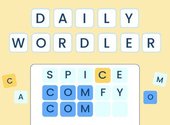
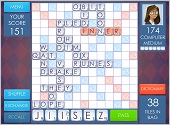
Word formation and strategy (Scrabble Outspell, Scrabble Wordmeister, Scrabble Sprint, Waffle Anagrams). These games give you a set of letters and challenge you to build words from them. In the Scrabble variants, you're also deciding where to place words on the board to maximize your score, which adds a spatial strategy layer on top of the vocabulary challenge.
Waffle Anagrams strips away the board and focuses purely on rearranging letters into words. These games exercise the broadest range of vocabulary because you need to consider many possible words, not just one specific target.
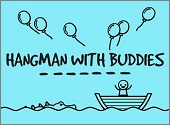
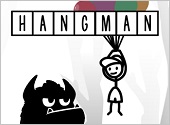
Word deduction (Hangman w/ Buddies, Hangman Monster, Wheel of Fortune, Cryptic Quotes). Instead of forming words, you're figuring out hidden words from partial information. In Hangman and Wheel of Fortune, each correct letter narrows the possibilities while each wrong guess carries a penalty.
Cryptic Quotes adds another layer: you're decoding substitution ciphers to reveal famous quotations, which means you're simultaneously doing pattern analysis and language prediction. These games test vocabulary depth (how many words you can recognize from fragments) rather than breadth (how many you can produce from scratch).
Word search and recognition (e.g., Trivia King, Waffle Anagrams). Word searches train rapid visual scanning, the ability to pick out meaningful letter patterns from a noisy visual field. It's a less demanding vocabulary exercise than Scrabble or Hangman, but it specifically targets the connection between visual pattern recognition and word identification.
Trivia King tests a different aspect of language: retrieving factual knowledge in response to verbal cues, which exercises semantic memory (the storehouse of facts and general knowledge).
Typing games (Type Run, Typing Fantasy, Typing Speed Test, Typing Zombie). These are also part of the Typing Games collection. They combine word recognition with rapid motor execution, training processing speed alongside the language network. See the typing games hub for tips on touch typing technique and how speed-of-processing training affects cognition.
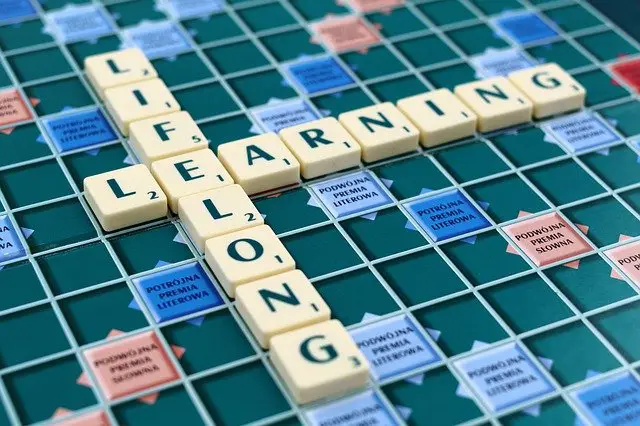
Word games directly exercise the brain's language retrieval network
What the Research Shows
The strongest clinical evidence for word games comes from crossword puzzle research, which is relevant because crosswords share key features with the Scrabble, Hangman, and cryptogram games in this collection: retrieving words from definitions or partial letter patterns, testing vocabulary breadth, and requiring search strategies.
A 78-week randomized controlled trial at Columbia and Duke compared crossword puzzle training with computerized cognitive games in 107 older adults with mild cognitive impairment (MCI). The crossword group showed superior performance on the primary cognitive outcome measure at both 12 weeks and 78 weeks.
They also showed better daily functioning scores and less brain shrinkage (measured by MRI) than the cognitive games group. The researchers noted that crosswords challenge retrieval memory, verbal knowledge, language skills, attention, processing speed, and executive function simultaneously.[2]
A separate longitudinal study followed 488 cognitively healthy older adults for years, tracking who later developed dementia. Among those who did develop dementia, individuals who reported regularly doing crossword puzzles experienced a delayed onset of accelerated memory decline by an average of 2.54 years compared to non-puzzlers.
This association held even after controlling for education level, suggesting that the benefit came from the activity itself rather than from general cognitive ability.[3]
These findings align with what we know about how the brain's language network works. Verbal fluency tasks (which ask you to generate as many words as possible matching a rule, such as "words starting with F") are among the most widely used measures in clinical neuropsychology because they simultaneously test lexical access ability and executive control.[1]
Word games like the ones on this page recreate that same dual demand in a more engaging format: you're searching your vocabulary (lexical access) while following game rules and constraints (executive control).
Getting the Most from Word Games
Don't always play it safe. In Scrabble-style games, it's tempting to play the first word you see. But the real cognitive workout comes from considering alternatives. Can you use a less common letter for more points? Is there a longer word hiding in those tiles?
Forcing yourself to search beyond the obvious answer exercises the "executive control" component of word retrieval, the ability to suppress the first response and keep looking for a better one.
Play games that challenge your vocabulary, not just confirm it. If you win easily every time, the game isn't making your brain work hard enough. The Scrabble games with AI opponents can be set to higher difficulties. Cryptic Quotes expose you to unfamiliar phrasing patterns. Variety keeps your language network engaged.
Mix word games with other categories. Word games primarily train language processing, but a well-rounded cognitive routine also includes games that train spatial reasoning (board games), processing speed (concentration games), and logical thinking (puzzles). The Brain Games guide explains how different game types target different cognitive skills.
If you enjoy word games, you might also like the printable puzzles section, which includes crossword puzzles and word search printables you can do with pencil and paper.
More Free Brain Games
Looking for other types? The full games directory has 200+ games organized by category, including board games, card & tile games, concentration games, math games, memory games, puzzles, and time management games.
Published: 10/04/2013
Last Updated: 02/22/2026
Content on this page adheres to my editorial standards. See the medical disclaimer regarding health-related information.
References & Research
I've reviewed these sources and selected them for their relevance to understanding how word games affect the brain's language network. Here's what each contributes:
1. Shao, Z., Janse, E., Visser, K., & Meyer, A. S. (2014). "What Do Verbal Fluency Tasks Measure? Predictors of Verbal Fluency Performance in Older Adults." Frontiers in Psychology, 5, 772. Full text at PMC
Researcher's Note: This study directly connects word-retrieval tasks to the cognitive skills that word games exercise. The researchers measured lexical access speed (how quickly people can retrieve words), vocabulary knowledge, and executive control (inhibition, updating) in 100 older Dutch adults. They found that verbal fluency performance depends on two independent abilities: lexical access speed and executive control, specifically the ability to suppress previously produced words while searching for new ones. This dual-demand structure is exactly what word games recreate. Scrabble requires you to access vocabulary (lexical access) while following board placement rules (executive control). Hangman requires you to generate candidate words (lexical access) while tracking which letters have been tried (updating). The paper's key insight is that these are separable cognitive components, which means different word games may train them in different proportions.
2. Devanand, D. P., Goldberg, T. E., Qian, M., Doraiswamy, P. M., et al. (2022). "Computerized Games versus Crosswords Training in Mild Cognitive Impairment." NEJM Evidence, 1(12). Full text at PMC
Researcher's Note: This is the strongest clinical trial evidence for word-based cognitive training. Researchers at Columbia and Duke randomized 107 adults with mild cognitive impairment to either crossword puzzles or computerized cognitive games for 78 weeks. The crossword group outperformed the games group on the primary cognitive outcome (ADAS-Cog) at both 12 and 78 weeks, showed better daily functioning, and had less brain shrinkage on MRI. What makes this study especially notable is that crosswords weren't just "as good as" purpose-built cognitive training software; they were significantly better. The researchers suggest this may be because crosswords simultaneously engage multiple cognitive systems: retrieval memory, verbal knowledge, processing speed, and executive function. These same demands are shared by many of the games in this collection.
3. Pillai, J. A., Hall, C. B., Dickson, D. W., Buschke, H., Lipton, R. B., & Verghese, J. (2011). "Association of Crossword Puzzle Participation with Memory Decline in Persons Who Develop Dementia." Journal of the International Neuropsychological Society, 17(6), 1006-1013. Full text at PMC
Researcher's Note: This longitudinal study from the Bronx Aging Study followed 488 community-dwelling older adults over many years. Among the 101 who eventually developed dementia, those who had reported doing crossword puzzles showed a 2.54-year delay in the onset of accelerated memory decline compared to non-puzzlers. The effect was independent of education level, which is important because it suggests the benefit came from the activity itself, not from having had more schooling. The study used a sophisticated statistical model (change-point analysis) to pinpoint when memory decline accelerated, rather than just comparing average scores. This is relevant to the word games on this page because it suggests that regular engagement with word-retrieval challenges may help maintain cognitive reserve over time, even if it doesn't prevent eventual decline.
Newest / Popular
Multiplayer
Board Games
Card & Tile
Concentration
Daily Games
Math / Memory
Puzzles
Time Mgmt
Word Games
- Retro Flash -
Also:
Bubble Pop
• Solitaire
• Tetris
Checkers
• Mahjong Tiles
•Typing
No sign-up or log-in needed. Just go to a game page and start playing! 

Sudoku, Kakuro, Word Searches, Crosswords, Slitherlink & more!
Hundreds of printable puzzles you can download, print, and solve with pencil and paper.

Hippocampus? Working memory? Spaced repetition?
Look up memory or brain terms in the A-Z glossary of definitions.