- Home
- Remember Numbers By Chunking
Chunking: The Simple Trick for Remembering Long Numbers
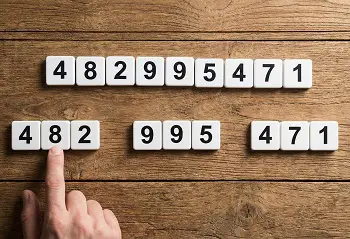
Try to memorize this number: 482995471. You have five seconds.
Difficult? Now try: 482 995 471. Same nine digits, but suddenly manageable. That's chunking in action, and it works because of how your brain is wired.
Research shows your working memory holds only about three to four separate items at once. Not seven, as you might have heard. Psychologist Nelson Cowan's work over the past two decades has revised that famous "seven plus or minus two" number down to a more modest three to five chunks for most people. Nine random digits far exceeds this limit. But three groups of numbers? That's within range.[1]
Chunking transforms long sequences into shorter, meaningful groups your brain can handle. It's why phone numbers have dashes, why credit cards are printed in blocks of four, and why Social Security numbers are formatted the way they are. These aren't arbitrary design choices. They're accommodations to human cognitive limits.
This technique is useful whenever you need to hold a number in your head briefly (writing down a phone number someone reads aloud) or remember one permanently (your bank account number, a door code). Let's look at how it works and how to use it effectively.
Why Your Brain Struggles with Long Numbers
Working memory is your brain's mental scratchpad. It's what you use to hold information while you're actively thinking about it: the phone number you need to dial, the items on your grocery list, the steps in a recipe you're following.
For decades, researchers cited George Miller's classic 1956 paper claiming we could hold "seven plus or minus two" items in short-term memory. But subsequent research by Cowan and others showed that Miller's estimate was too generous. When you prevent people from using strategies like rehearsal (silently repeating items) or grouping, the true limit is closer to three or four items.[2]
This matters because numbers don't come with built-in meaning. The word "alligator" is nine letters, but your brain treats it as a single chunk because it's a meaningful concept you've encountered thousands of times. The number 482995471 is also nine items, but your brain must treat each digit separately, and nine separate items far exceeds your working memory's capacity.
Here's a demonstration. Try to remember this sequence of random letters:
R A I O L T A L G
Notice the mental strain? Nine separate letters pushing against your memory's limits. Now, same letters, different order:
A L L I G A T O R
Instant recognition. No effort required. Your brain automatically chunked nine letters into one meaningful unit. The magic isn't in the letters themselves but in the meaning they carry when arranged correctly.
Numbers rarely form words, so we need deliberate strategies to chunk them. Fortunately, there are two effective approaches: direct chunking (using spacing) and alphabetic chunking (converting numbers to letters and words).
Direct Chunking: The Quick Method
Direct chunking is exactly what it sounds like: breaking a long number into smaller groups using spaces, dashes, or pauses. It requires no special training and works immediately.

Consider a ten-digit phone number:
5558675309
Ten digits exceed most people's working memory capacity. If someone reads this to you quickly, you'll likely lose digits before you can write them down. Now with chunking:
555-867-5309
Read each chunk as a group: "five fifty-five... eight sixty-seven... fifty-three oh-nine." What was ten separate items becomes three manageable units. Even if each chunk contains multiple digits, your brain treats the chunk itself as a single item in working memory.
The key is keeping each chunk small enough to process easily. Research suggests three or four items per chunk works well for most people. Compare these two approaches to the same number:
555-867-5309 ✓
55586-75-309 ✗
The second version doesn't help much because the first chunk (55586) is itself five items, which pushes your working memory's limits.
When Direct Chunking Works Best
Direct chunking excels in situations where you need to hold a number temporarily:
Writing down a number someone reads aloud. Ask them to pause between chunks. "What's your account number?" "It's 4829... 7361... 0054." The pauses give you time to write each chunk before receiving the next one.
Dialing a phone number you just looked up. Read it in chunks, dial in chunks. Don't try to memorize all ten digits at once.
Entering a credit card number online. The four-digit groups printed on your card aren't just for readability. They're cognitive scaffolding, helping you transfer the number accurately from card to screen.
For permanent memorization, direct chunking can work but requires additional reinforcement through spaced repetition. You'll need to review the number at increasing intervals until it moves into long-term memory. Many people naturally do this with frequently used numbers like their own phone number or Social Security number.
Alphabetic Chunking: The Power Method
What if you need to memorize a long number permanently and quickly? Direct chunking with repetition works, but there's a more powerful approach: convert the number into words.

This technique, sometimes called the Major System or phonetic number method, assigns consonant sounds to digits. Once you've memorized the conversion code, you can turn any number into words, then into a memorable image.
For example: the number 9412714154271 becomes "Boy riding turtle wearing hat." Both represent the same information, but one is far easier to remember, especially if you visualize the scene vividly.
The conversion uses a consistent code:
0 = s, z (zero starts with "z")
1 = t, d (one downstroke)
2 = n (two downstrokes)
3 = m (three downstrokes)
4 = r (four ends in "r")
5 = l (L is the Roman numeral for 50)
6 = j, ch, sh (J looks like a reversed 6)
7 = k, hard g (K looks like two 7s back to back)
8 = f, v (cursive f looks like 8)
9 = p, b (9 is a mirror of P)
Vowels and the consonants w, h, and y don't count, so you can insert them freely to form words. The number 21 could become "net," "nut," "knot," or "night," all of which use n (2) and t (1).
This method requires an upfront investment to memorize the code, but once you have it, you can encode any number into memorable phrases. Memory competitors use this system routinely to memorize hundreds of digits.
For a complete guide to learning and using this system, see the Major System page.
Practical Applications
Beyond phone numbers, chunking helps with many everyday number challenges:
PIN codes and passwords. A six-digit PIN like 847291 becomes 84-72-91, three two-digit chunks. Or find meaning: maybe 84 is your birth year, 72 is your grandmother's age, 91 is when you graduated.
Account numbers. Bank and investment accounts often run 10-12 digits. Chunk them into groups of three or four, and use spaced repetition to commit them to long-term memory.
Medical ID numbers. If you have a chronic condition requiring frequent healthcare visits, knowing your insurance ID by heart saves time. Chunk it, review it periodically, and it becomes automatic.
Door codes and combinations. Gym locker, office building, garage door: each is an opportunity to practice chunking. A four-digit code like 7439 becomes 74-39 (two chunks) rather than four separate digits.
Speaking Numbers to Others
When you give a number to someone else, chunk it for them and pause between groups. Don't rattle off "nine eight seven eight six four seven one zero zero seven" in one breath. Instead:
"Nine eighty-seven... [pause] ... eight sixty-four... [pause] ... seven ten... [pause] ... oh-seven."
The pauses give the listener time to write each chunk before receiving the next one. This small courtesy dramatically reduces errors and frustration on both ends.
If you're reading a very long number (like a wire transfer routing number), consider breaking it into even more chunks with longer pauses. Better to go slowly than to repeat the entire number because someone lost track.
The Limits of Chunking
Chunking is powerful, but it has constraints worth understanding.
Chunk size matters. Keeping chunks to three or four items works for most people. Larger chunks lose the benefit.
Meaning helps. "1776" is easier to remember than "7617" because the first carries historical meaning. Look for patterns and associations that make chunks meaningful.
Attention is required. Chunking doesn't work if you're not paying attention in the first place. The technique organizes information, but you still need to focus while encoding it.
Long-term storage needs reinforcement. Direct chunking alone won't permanently memorize a number. You'll need either repetition over time or a conversion to meaningful words (alphabetic chunking).
Getting Started
You're probably already using chunking without realizing it. The next step is making it deliberate:
For temporary storage: When you need to hold a number briefly, break it into chunks of three or four digits. Say each chunk aloud or subvocally, pausing between groups.
For permanent memorization: Either use chunking plus spaced repetition (reviewing at increasing intervals), or invest in learning the Major System to convert numbers to memorable words.
When giving numbers to others: Chunk and pause. Your listener's brain has the same limitations yours does.
The simplest memory techniques are often the most useful. Chunking won't let you memorize pi to a thousand digits (that requires the alphabetic method), but for everyday number challenges, it's often all you need.
References
These sources informed my understanding of working memory limits and chunking. See our editorial standards for how I evaluate research.
1. Cowan, N. (2010). "The Magical Mystery Four: How is Working Memory Capacity Limited, and Why?" Current Directions in Psychological Science, 19(1), 51-57. Free full text at PMC
Researcher's Note: This accessible review summarizes decades of Cowan's research on working memory capacity. The key finding: when you prevent rehearsal and grouping strategies, people can hold only about 3-4 separate chunks in working memory, not the famous "seven plus or minus two." This has direct implications for how we should structure information we want to remember.
2. Cowan, N. (2001). "The magical number 4 in short-term memory: A reconsideration of mental storage capacity." Behavioral and Brain Sciences, 24(1), 87-185. Cambridge Core
Researcher's Note: The landmark paper that revised our understanding of working memory limits. Miller's 1956 "seven plus or minus two" estimate was based on tasks that allowed rehearsal and other strategies. When these are controlled, the true capacity limit appears to be about four chunks. This paper sparked substantial debate and follow-up research, but the lower estimate has held up well.
3. Miller, G.A. (1956). "The magical number seven, plus or minus two: Some limits on our capacity for processing information." Psychological Review, 63(2), 81-97. Classics in the History of Psychology
Researcher's Note: One of the most cited papers in psychology. Miller introduced the concept of "chunking" as a way to explain how we can remember more than our raw capacity would suggest. While his specific number (seven) has been revised downward by subsequent research, his insight about chunking remains foundational to memory science.
4. Chen, Z. & Cowan, N. (2009). "Core verbal working-memory capacity: The limit in words retained without covert articulation." Quarterly Journal of Experimental Psychology, 62(7), 1420-1429. Free full text at PMC
Researcher's Note: This study tested what happens when you prevent people from silently rehearsing words. The result: people could remember only about 3 chunks, whether those chunks were single words or learned word pairs. This confirms that the ~4-chunk limit is real and not an artifact of task design.
Published: 07/17/2014
Last Updated: 01/14/2026
Newest / Popular
Multiplayer
Board Games
Card & Tile
Concentration
Daily Games
Math / Memory
Puzzles
Time Mgmt
Word Games
- Retro Flash -
Also:
Bubble Pop
• Solitaire
• Tetris
Checkers
• Mahjong Tiles
•Typing
No sign-up or log-in needed. Just go to a game page and start playing! 

Sudoku, Kakuro, Word Searches, Crosswords, Slitherlink & more!
Hundreds of printable puzzles you can download, print, and solve with pencil and paper.

Hippocampus? Working memory? Spaced repetition?
Look up memory or brain terms in the A-Z glossary of definitions.