- Home
- Brain Games
- Free Online Brain Games
- Play Minesweeper Online
Play Minesweeper Online - Free Classic Puzzle Game
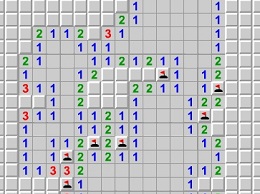
For roughly two decades, Minesweeper shipped with every copy of Windows. It became one of the most-played games in computing history, not because anyone marketed it, but because it was sitting right there on hundreds of millions of computers.
The premise is deceptively simple: clear a grid without hitting a hidden mine. The reality is a tight little logic puzzle that punishes carelessness and rewards careful thinking.
This game is part of the free online brain games collection on this site.
How to Play Minesweeper
To begin, click the Small, Medium, or Large button under the picture of the game. This opens the game in a pop-up window.
The goal is to uncover every square on the grid that doesn't contain a mine. Click a square and one of three things happens: it's a mine and the game ends, it's blank (meaning no mines touch it and the surrounding blank area also opens automatically), or it shows a number from 1 to 8.
That number is the only information you have to work with, and it's enough. The number tells you exactly how many mines are hiding in the eight squares immediately around it. A "1" means one of those eight squares is a mine. A "3" means three of them are. Your job is to figure out which.
You win when every non-mine square has been uncovered. You lose if you uncover even one mine.
Controls and Difficulty
This version of Minesweeper uses a mode-toggle system rather than the classic right-click flag. At the bottom of the play area you'll see two buttons: a shovel and a flag. Tap the one for the action you want.
Digging mode (shovel button). When the shovel is selected, tapping a square uncovers it. The first tap is always safe.
Flagging mode (flag button). Switch to the flag button when you want to mark a square as a mine. Tap any square to plant or remove a flag. Switch back to the shovel to keep digging.
This two-mode approach feels slower than right-click flagging at first, but it works well on touch screens and prevents the accidental mine-clicks that ruin a game.
Mine counter and timer. The display at the top shows how many mines remain unflagged and how long the current game has been running.
Difficulty modes. Three options at the start screen:
• Easy: 12 × 8 grid, 10 mines
• Normal: 18 × 12 grid, 32 mines
• Hard: 22 × 15 grid, 64 mines
Best Time scores are tracked per difficulty mode. Start with Easy until you have the pattern recognition down, then move up.
The Logic of Minesweeper
Most Minesweeper players figure out the basics in a few minutes, then plateau. The difference between an average player and a fast one is pattern recognition. There are only so many configurations of numbers that can appear, and the most common ones have deterministic solutions once you learn to spot them.
The corner 1. If a "1" appears in a corner with only one adjacent unopened square, that square is the mine. Flag it.
The wall 1. A "1" sitting against a wall with one adjacent unopened square also identifies a mine. Same principle.
The 1-2-1 pattern. When three numbers in a straight line read 1-2-1, with unopened squares directly beside them, the mines are in the squares beside the two outer 1s. The square beside the middle 2 is safe.
The 1-2-2-1 pattern. When four numbers read 1-2-2-1 in a line, the mines are in the squares beside the two 2s. The squares beside the 1s are safe.
Counting flags. Once you've flagged all the mines around a particular number, every other adjacent square is safe. You can tap them confidently.
Tips for Getting Better
Open up territory before committing. When the board is mostly empty and you're not sure where to click, pick a square in unexplored space rather than guessing on the edge of explored territory. New space is more likely to open up a large blank area, which gives you more numbers to work with.
Flag what you've identified. The mode-toggle flag system feels slower than right-click flagging, so beginners are tempted to skip flagging and keep mine locations in their head. That works on Easy, fails on Normal and Hard. Switch to flag mode and mark each mine the moment you've identified it. Mental load drops dramatically.
When stuck, look for forced moves. If progress feels impossible, scan the entire perimeter of opened squares for one of the recognizable patterns above. There's almost always a forced move somewhere that you've missed.
Accept that some games require guessing. On Hard difficulty especially, some positions are mathematically ambiguous: two squares might be 50/50, with no logical way to determine which is safe. Calculate the odds and make the choice. Losing a game to a forced guess is part of the game.
Speed comes from pattern recognition, not faster clicking. Top players don't think faster, they recognize patterns instantly. Time spent learning the common configurations pays off more than time spent practicing speed-clicking.
A Brief History of Minesweeper
Minesweeper was originally written by Microsoft programmer Curt Johnson for IBM's OS/2 operating system. Robert Donner ported it to Windows, and it first appeared in the Microsoft Entertainment Pack 1 in 1990. Two years later, Microsoft included it with Windows 3.1 as a standard system game, replacing Reversi from Windows 3.0.
The game stayed in every standard Windows install through Windows 7. Microsoft removed it from Windows 8 in 2012, replacing the default install with a free version on the Microsoft Store. By the time it was removed, it had been included with Windows for two decades, played by an audience that no other puzzle game in history has ever matched.
The game's design wasn't entirely original. Microsoft's developers have acknowledged drawing on earlier minefield puzzle games, with some sources crediting Ian Andrew's 1983 ZX Spectrum game "Mined-Out" as a key influence. But it was Microsoft's version, polished and shipped to every Windows PC for twenty years, that made Minesweeper into a cultural fixture.
What Minesweeper Does for Your Brain
Minesweeper looks like a casual game, but the cognitive work involved is more substantial than the premise suggests.
Logical deduction. Every move except the first is a deductive inference. Given the visible numbers, where must the mines be? That's pure formal logic, and the game's appeal as a brain exercise comes largely from this. Unlike most puzzle games, Minesweeper rarely lets you guess your way through. You either deduce the answer or you don't.
Pattern recognition. The patterns described above are mental shortcuts that experienced players spot instantly. Building that pattern library is exactly the kind of expertise development that researchers point to when they describe how chess masters or radiologists work: not faster thinking, but better recognition of recurring configurations.
Working memory. On a larger board, you're holding multiple in-progress deductions in mind at once. "If the square at position A is safe, then position B must be a mine, which means position C is also safe..." That kind of chained reasoning under uncertainty is genuine working memory exercise.
Probabilistic thinking. When deduction runs out and you face a 50/50 guess, the game forces you to think probabilistically. Some Minesweeper positions have non-obvious odds that experienced players learn to calculate. That comfort with reasoning under uncertainty is a transferable skill far beyond the game board.
If you enjoy this kind of logical puzzle, you might also like the Battleship game online or the main brain games directory for more options.
Published: 04/24/2021
Last Updated: 05/16/2026
Newest / Popular
Multiplayer
Board Games
Card & Tile
Concentration
Daily Games
Math / Memory
Puzzles
Time Mgmt
Word Games
- Retro Flash -
Also:
Bubble Pop
• Solitaire
• Tetris
Checkers
• Mahjong Tiles
•Typing
No sign-up or log-in needed. Just go to a game page and start playing! 

Sudoku, Kakuro, Word Searches, Crosswords, Slitherlink & more!
Hundreds of printable puzzles you can download, print, and solve with pencil and paper.

Hippocampus? Working memory? Spaced repetition?
Look up memory or brain terms in the A-Z glossary of definitions.