- Home
- Keyword Method
The Keyword Method: How to Memorize Vocabulary, Definitions, and More
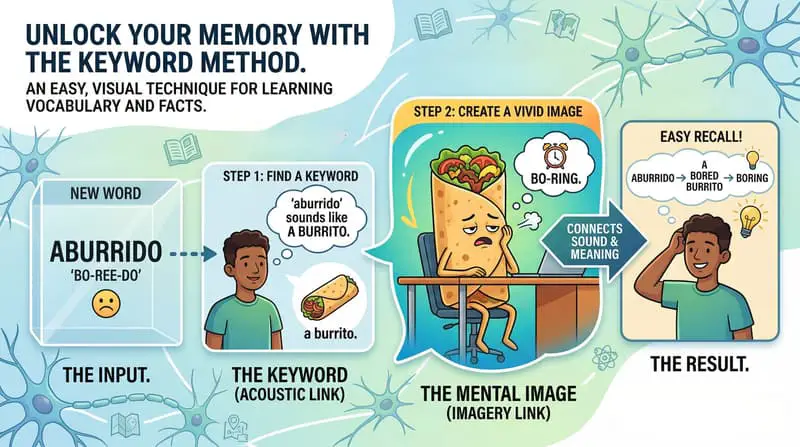
The Spanish word "aburrido" (meaning: boring) sounds like "a burrito".
In 1975, psychologists Richard Atkinson and Michael Raugh tested a memorization technique on Stanford students learning Russian. One group used a specific two-step method. The other group studied however they wished.
On the recall test, the technique group significantly outperformed the controls. The method was straightforward: find an English word that sounds like the Russian word, then create a mental image linking that sound-alike word to the meaning.[1]
That technique is the Keyword Method, and five decades of research have confirmed its effectiveness. A comprehensive review of nearly 50 studies found that it consistently produced superior recall compared to other vocabulary learning strategies, across different ages, languages, and types of material.[2]
The Keyword Method works for foreign vocabulary, English definitions, medical terminology, names paired with facts, and virtually any situation where you need to connect an unfamiliar word to its meaning. It is one of several memory techniques that use visualization and association as their core mechanism.
The Two-Step Process
The Keyword Method connects an unfamiliar word to its meaning through two links:
Step 1: The acoustic link. Listen to the unfamiliar word and find a familiar, concrete word that sounds similar. This sound-alike word is your "keyword." It does not need to be an exact phonetic match. A rough resemblance is enough, because your brain will bridge the gap.
Step 2: The imagery link. Create a vivid mental image that connects your keyword to the actual meaning of the word. The image should show the two concepts interacting, not just sitting side by side.
Two links in a chain: unfamiliar word → keyword (sounds like it) → mental image (shows the meaning).
Consider the animation below. Students learning geometry sometimes confuse "radius" and "diameter." The word "radius" sounds like "radish." Now picture a radish swinging back and forth from the center of a circle to its edge. That is what a radius is: the distance from center to edge.
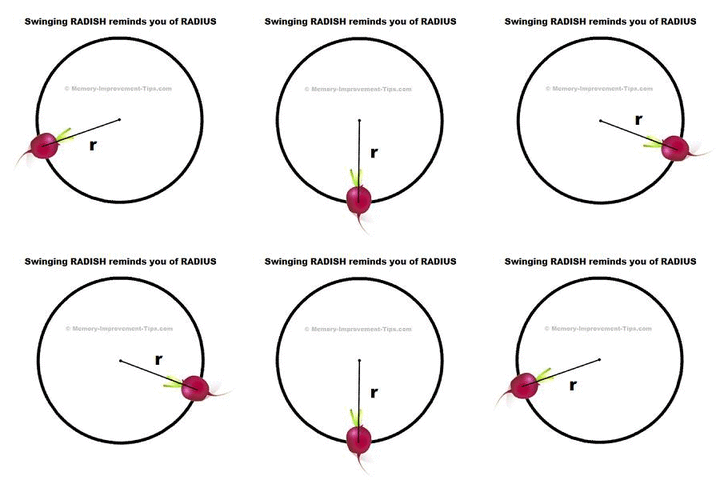
Study the animation for a moment. When someone says "radius," the sound triggers "radish," which triggers the image of something swinging from the center of a circle. Could you confuse radius with diameter after that?
Why It Works
The Keyword Method is effective because it encodes information through two channels simultaneously. Allan Paivio's dual coding theory explains why this matters: your brain processes verbal information (words, sounds) and visual information (images, spatial relationships) through separate but connected systems.
When you create a keyword image, you lay down both a verbal trace (the sound connection) and a visual one (the mental picture). If one fades, the other can still trigger recall.[3]
This is also why the method outperforms rote repetition. Repeating a word over and over creates only a single, thin verbal trace. The Keyword Method builds a richer encoding with multiple retrieval paths. You can reach the meaning through the sound, through the image, or through the interaction between them.
How to Create Good Keywords
Finding the right keyword is the part beginners struggle with most. These guidelines will help:
Listen for the dominant sounds. You do not need a perfect phonetic match. A keyword that captures the most prominent syllable or two is sufficient. Your brain fills in the rest. "Radish" does not sound exactly like "radius," but it is close enough.
Use concrete nouns whenever possible. Words you can picture (radish, bell, rose, hammer) make better keywords than abstract concepts. If the sound suggests an action instead, that works too.
Build images with interaction. Do not just picture a radish next to a circle. Picture it swinging inside the circle, smashing through it, or growing out of its center. Interaction creates a stronger memory trace than passive side-by-side placement.
Aim for vividness over weirdness. Research suggests that how clearly you imagine the image matters more than how bizarre it is. A detailed, vivid image outperforms a vague "weird" one. That said, unusual or impossible images tend to be naturally vivid, which is why memory experts often recommend them.[2]
For longer words, break them into pieces. A multi-syllable word can become two or three smaller keywords chained together. The Italian word for "teacher" is insegnante. Break it down: "hen's egg + nine + tea."
Now picture a giant hen's egg with a face and nine arms, each holding a cup of tea, standing at a blackboard lecturing a class. Every time it waves an arm to make a point, tea splashes everywhere. For more examples of this approach, see memorizing foreign vocabulary.
Spend a few deliberate seconds on each image. The encoding does not need to be slow, but it does need to be intentional. Rushing through without clearly visualizing defeats the purpose.
More Examples
Remembering facts about people. Suppose you are reading about classical music and want to remember that Hungarian composer Bela Bartok was a master pianist.
"Bela" sounds like "bell." "Bartok" sounds like "bar talk." Imagine a giant bell sitting on top of a piano in a noisy bar, and everyone is talking about it. The bell clangs away while someone tries to play the piano underneath it.
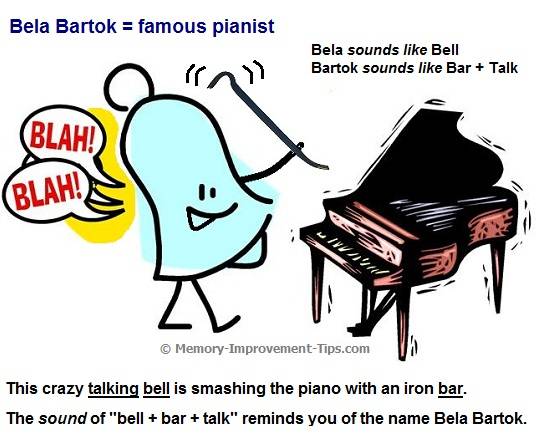
Now when you hear "Bela Bartok," the sounds trigger bell → bar → talk → piano. He was the famous pianist. Review the image once or twice, and it locks in.
Foreign language vocabulary. This is where the Keyword Method really shines, and it is the application that has been most extensively studied. The Spanish word for rice is el arroz, pronounced roughly like "a rose."
Picture a single red rose growing straight out of a bowl of steaming white rice. The sound "arroz" triggers "a rose," which triggers the image of rice. That is all it takes.
The method works across languages, from Spanish to Russian to Japanese. It does not depend on the writing system, because it operates on the sound of the word, not the spelling. For dozens of fully worked examples across French, Spanish, Russian, and Italian, see my page on memorizing foreign vocabulary.
Medical and scientific terminology. The Keyword Method is especially useful in fields where long, unfamiliar terms must be connected to precise definitions. The approach is the same: break the term into phonetic chunks, find concrete keywords for each chunk, and build an image that captures the meaning.
A medical student learning "bradycardia" (abnormally slow heart rate) might hear "Brady + card + ya" and picture Tom Brady slowly, very slowly, dealing a hand of cards to someone. The slow motion is the meaning. For detailed medical examples, see remembering medical terms.
Information Technology. Here's a keyword example infographic from computer science linking the meaning of the technical term Domain Name System (DNS) with the sound of its acronym:
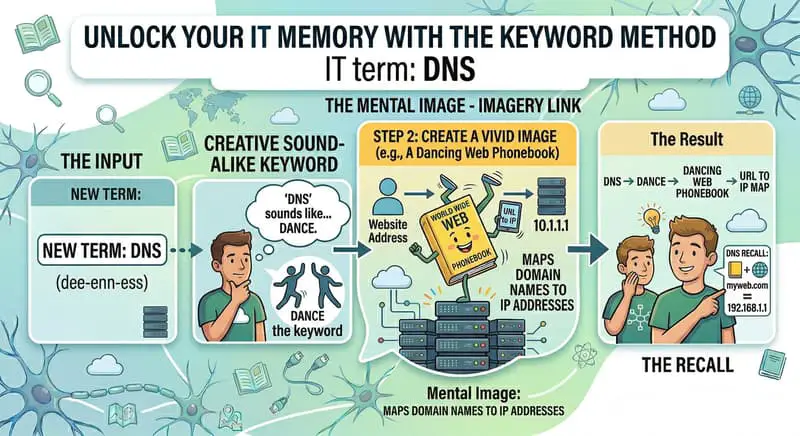
The IT term "DNS" sounds like "dance." You can use this to create a mental image reminding you of its meaning.
As you can see, the keyword method can be adapted to the vocabulary of any knowledge area. The use of "sound alike" words in the technique provides this flexibility.
When the Keyword Method Works Best
The Keyword Method excels at connecting two pieces of information: a word and its meaning. Its strongest applications include foreign language vocabulary (its original and most researched use), English definitions and standardized test preparation, medical and scientific terminology, and names paired with facts.
For sequential lists, speeches, or large bodies of information that need to be recalled in order, the Link Method or Memory Palace are usually better choices. Those methods connect many items in sequence. The Keyword Method connects pairs. Each tool has its strengths, and experienced memorizers use them in combination. (For an overview of all the techniques and when to use each, see memory skills.)
Making Keywords Stick: Combine with Spaced Repetition
The Keyword Method handles the encoding problem brilliantly. But encoding alone does not guarantee long-term retention. If you learn 50 Spanish words with keywords on Monday and never review them, many of those images will fade.
Research has found that the keyword method's benefits can weaken over time without review, but that combining it with retrieval practice (self-testing) helps sustain the gains.[4]
This is where spaced repetition comes in. After creating your keyword images, review them at gradually increasing intervals: after a few minutes, then a day, then a few days, then a week, then longer. Physical flashcards or apps like Anki work well for this. Write the foreign word on one side and the definition on the other, with a brief note about your keyword image.
The keyword image gets the information into your memory. Spaced repetition keeps it there. Together, they cover both halves of the memory skills equation: encoding and retention.
Go Deeper
The Keyword Method is one of several powerful memory techniques, all built on the foundation of visualization and association. If you want to explore further, these pages provide detailed examples and applications:
Applications by subject: Memorizing foreign vocabulary (with illustrated examples in French, Spanish, Russian, and Italian) • Memorizing English vocabulary (SAT and GRE preparation) • Remembering medical terms (with worked examples and a video walkthrough)
Related techniques: Memory Palace (for ordered sequences) • Link Method (for chaining items together) • Spaced repetition (for long-term retention of anything you encode)
For a fuller picture of how memory techniques, learning strategies, and brain health work together, see the Memory Skills hub.
References & Research
These sources cover the origin, mechanism, and practical effectiveness of the Keyword Method. Here is what each contributes:
1. Atkinson, R.C. & Raugh, M.R. (1975). "An application of the mnemonic keyword method to the acquisition of a Russian vocabulary." Journal of Experimental Psychology: Human Learning and Memory, 1(2), 126-133. PDF from author's page
Researcher's Note: The foundational study that established the Keyword Method as a formal technique. Atkinson and Raugh tested Stanford students learning Russian vocabulary and found that the keyword group significantly outperformed the control group. This paper defined the two-step framework (acoustic link followed by imagery link) that every subsequent study builds on. Note that the study used experimenter-supplied keywords; the authors themselves raised the question of whether learner-generated keywords might work differently.
2. Pressley, M., Levin, J.R., & Delaney, H.D. (1982). "The mnemonic keyword method." Review of Educational Research, 52(1), 61-91. SAGE Journals
Researcher's Note: The most comprehensive early review of keyword method research, synthesizing nearly 50 studies across different age groups, content areas, and experimental designs. Pressley and colleagues confirmed that the method consistently outperformed other strategies for recalling definitions from vocabulary words. They also noted that image vividness matters more than image bizarreness for recall, an important practical point.
3. Clark, J.M. & Paivio, A. (1991). "Dual coding theory and education." Educational Psychology Review, 3(3), 149-210. Free PDF at CSU Chico
Researcher's Note: This paper applies Paivio's dual coding theory to educational settings. Verbal and visual information are processed through separate channels; engaging both creates redundant memory traces. This is the scientific foundation for why the Keyword Method's combination of sound (verbal channel) and imagery (visual channel) produces stronger encoding than either channel alone.
4. Qu, K., Liu, T., Qiao, Y., & Wang, P. (2024). "The facilitative effect of the keyword mnemonic on L2 vocabulary retrieval practice." Heliyon, 10(3), e25242. Free full text at PMC
Researcher's Note: A recent study examining what happens when you combine the Keyword Method with retrieval practice (self-testing). The results show that the keyword mnemonic can boost initial retrieval success rates, which is important because retrieval practice only produces strong long-term benefits when learners achieve a reasonable level of initial success. This supports the practical recommendation to pair keyword encoding with spaced, active review.
5. Cepeda, N.J., Pashler, H., Vul, E., Wixted, J.T., & Rohrer, D. (2006). "Distributed practice in verbal recall tasks: A review and quantitative synthesis." Psychological Bulletin, 132(3), 354-380. Free PDF
Researcher's Note: This meta-analysis synthesizes decades of research confirming that distributing practice over time produces substantially better long-term retention than massing practice into a single session. The keyword method handles the encoding; spacing handles the retention. If you are using the Keyword Method to learn vocabulary and want the results to last, this is the evidence for why a spaced review schedule matters.
Published: 02/07/2007
Last Updated: 04/01/2026

Newest / Popular
Multiplayer
Board Games
Card & Tile
Concentration
Daily Games
Math / Memory
Puzzles
Time Mgmt
Word Games
- Retro Flash -
Also:
Bubble Pop
• Solitaire
• Tetris
Checkers
• Mahjong Tiles
•Typing
No sign-up or log-in needed. Just go to a game page and start playing! 

Sudoku, Kakuro, Word Searches, Crosswords, Slitherlink & more!
Hundreds of printable puzzles you can download, print, and solve with pencil and paper.

Hippocampus? Working memory? Spaced repetition?
Look up memory or brain terms in the A-Z glossary of definitions.