- Home
- Brain Games
- Printable Puzzles
- Printable Slitherlink
150 Free Printable Slitherlink Puzzles
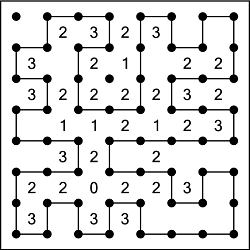
Free Slitherlink puzzles you can download and print. Each puzzle is a single page PDF with plenty of room to work. Solutions are provided separately so you won't accidentally see the answer.
Slitherlink (also called "Fences" or "Loop the Loop") is one of the most popular logic puzzles after Sudoku. You draw a single continuous loop on a grid of dots, using the numbers as clues. No math required, just pure deduction.
What sets Slitherlink apart from most logic puzzles is that you're building something visual. Instead of filling in numbers, you're drawing a path, and every segment you add changes the shape of what's possible. It's spatial reasoning in its purest form: you're constantly asking whether a line can exist without breaking the loop or violating a clue.
Jump to: Easy (50) • Medium (50) • Hard (50) • Slitherlink Rules • Terms of Use
These printables are designed for comfortable paper solving. The dot grids are clearly spaced with room to draw lines and mark excluded edges. Each difficulty uses a different grid size (7×7, 11×11, or 15×15), so you can start small and work up. Solutions are in separate files, so there's no risk of a stray glance spoiling your progress.
Click any puzzle link to open the PDF in a new tab, then print or save. All puzzles are free for personal and organizational use.
50 Easy Slitherlink (7×7)
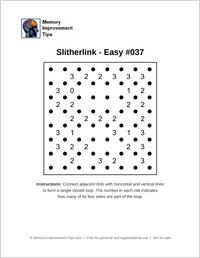
A good starting point if you're new to Slitherlink. These 7×7 grids have plenty of given numbers, so you'll rarely get stuck for long. Most can be solved using a handful of basic patterns: 0s that exclude all surrounding edges, 3s in corners that force specific segments, and pairs of adjacent 3s that lock in shared edges.
The small grid size means you can see the entire puzzle at a glance, which makes it easier to spot how one deduction affects the rest of the loop. Expect each puzzle to take five to ten minutes once you're familiar with the common patterns.
If you've solved Sudoku but never tried a loop puzzle, Slitherlink will feel like a different kind of challenge. There's no number placement here. Instead, you're reasoning about connectivity: can this edge be part of the loop without creating a dead end or closing the loop too early?
50 Medium Slitherlink (11×11)
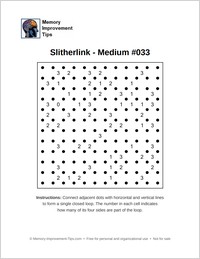
A step up in both grid size and reasoning depth. These 11×11 puzzles have fewer given numbers relative to the grid area, so you'll need to work harder to find your footholds. The basic patterns still apply, but they'll only get you partway through.
At this size, you'll start encountering situations where no single clue resolves immediately. Instead, you'll need to combine information from multiple clues and track the loop's path across larger sections of the grid. Marking excluded edges becomes essential.
The 11×11 grid hits a sweet spot for most solvers: large enough to require sustained concentration for 15 to 25 minutes, but not so large that you lose track of the overall loop shape. A good choice for a lunch break or evening wind-down.
50 Hard Slitherlink (15×15)
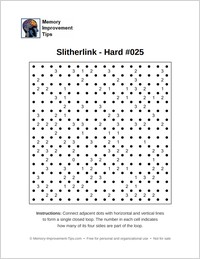
Full-size 15×15 Slitherlink for experienced solvers. These grids are large enough that you can't hold the entire loop in your head at once, and the sparser clue distribution means longer stretches of reasoning before you can confirm a segment.
You'll rely heavily on edge exclusion, connectivity reasoning, and the constraint that the loop must close without branching. Situations where you need to think two or three moves ahead become common. A pencil with a good eraser is your best friend.
Expect these to take 30 minutes or more. If you get stuck, try working from a different corner of the grid. Often a deduction in one area will propagate constraints that unlock progress elsewhere. Don't hesitate to check the solution file for a single tricky section rather than starting over.
How to Solve Slitherlink
Slitherlink is played on a grid of dots. Some squares contain numbers from 0 to 3. Your goal is to connect the dots with horizontal and vertical lines to form a single continuous loop.
The rules:
1. Draw lines between adjacent dots to create one closed loop.
2. The loop cannot branch or cross itself.
3. Each number indicates exactly how many of its four surrounding edges are part of the loop.
4. Squares without numbers may have any number of edges (0 to 4) as part of the loop.
Basic strategies:
Start with 0s and 3s. A "0" means none of its edges are part of the loop, so you can mentally mark all four edges as excluded. A "3" in a corner must have exactly those three available edges as part of the loop. These are the easiest starting points.
Adjacent 3s are powerful. Two 3s that share an edge must both use that shared edge. The loop passes straight through between them. This pattern lets you immediately draw several segments.
Watch the corners. If a line enters a corner dot, it must exit. Since lines can't dead-end, corners often force specific paths. A "3" in a corner of the grid, for instance, has a very limited solution.
Use X marks for excluded edges. Just as important as drawing lines is marking edges that definitely aren't part of the loop. If a dot already has two lines meeting it (forming part of the loop), its other edges can be marked as excluded.
Prevent early closure. The loop can't close until it includes all required segments. If drawing a line would create a small closed loop that leaves other numbers unsatisfied, that line is wrong.
Printing Tips
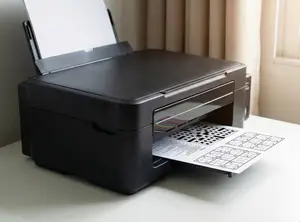
Each puzzle is a single-page PDF designed for standard letter-size (8.5×11") paper. They also print well on A4. For the best results, use your browser's "Fit to page" setting and make sure "Print backgrounds" is turned off (it should be by default). The puzzles are black and white, so they work fine on any printer.
If you're printing for a group (for example, a classroom, a company event, a senior center activity, or family game night), feel free to print as many copies as you need. The solution files are separate, so hand out puzzles without worrying about answers being visible on the back.
Prefer to solve on a tablet? The PDFs also work well with stylus-based annotation apps. Just open the file and write directly on the screen.
Why Slitherlink?
Slitherlink exercises spatial reasoning and pattern recognition in ways that number-placement puzzles don't. You're constantly thinking about connectivity: how segments relate to each other across the grid, where the loop can and can't go.
The puzzle also rewards learning visual patterns. Experienced solvers recognize common configurations instantly, the same way chess players recognize board positions. This pattern library builds over time and transfers to other spatial reasoning tasks.
Many solvers find Slitherlink more relaxing than Sudoku. There's something satisfying about watching the loop gradually take shape, filling in segment by segment until it closes.
For more about the cognitive aspects of puzzles, see my Brain Games overview.
More Printable Puzzles
This page is part of my Printable Puzzles collection. I'm adding new puzzle types regularly.
You might also enjoy my Printable Sudoku, Printable Kakuro, or Printable Futoshiki.
Terms of Use
These puzzles are free for personal use and for organizations, including classrooms, senior centers, memory care facilities, homeschool groups, clubs, churches, and workplaces. You may print as many copies as you need. Please don't sell them or remove the copyright notice.
Publishers: You may include one or two puzzles in each newsletter or bulletin with attribution to Memory-Improvement-Tips.com.
Published: 01/29/2026
Last Updated: 04/30/2026
Newest / Popular
Multiplayer
Board Games
Card & Tile
Concentration
Daily Games
Math / Memory
Puzzles
Time Mgmt
Word Games
- Retro Flash -
Also:
Bubble Pop
• Solitaire
• Tetris
Checkers
• Mahjong Tiles
•Typing
No sign-up or log-in needed. Just go to a game page and start playing! 

Sudoku, Kakuro, Word Searches, Crosswords, Slitherlink & more!
Hundreds of printable puzzles you can download, print, and solve with pencil and paper.

Hippocampus? Working memory? Spaced repetition?
Look up memory or brain terms in the A-Z glossary of definitions.