- Home
- Brain Games
- Printable Puzzles
- Printable Kakuro
150 Free Printable Kakuro Puzzles
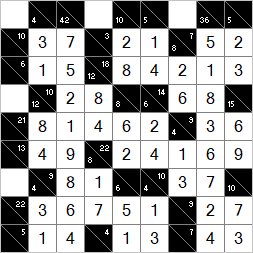
Free Kakuro puzzles you can download and print. Each puzzle is a single page PDF with plenty of room to write. Solutions are provided separately so you won't accidentally see the answer.
Kakuro is often described as a crossword puzzle with numbers. Each run of white cells must add up to the clue in its shaded cell, using only digits 1 through 9 with no repeats. That "no repeats" rule is what makes it a logic puzzle rather than just arithmetic. You're constantly reasoning about which combinations are possible given the constraints from crossing runs.
What makes Kakuro stand out from other number puzzles is the interplay between addition and elimination. A clue of 16 across three cells has several possible combinations, but once you know one digit from a crossing vertical run, the remaining possibilities collapse quickly. That chain reaction is where the satisfaction comes from.
Jump to: Easy (50) • Medium (50) • Hard (50) • Kakuro Rules • Terms of Use
These printables are designed for comfortable paper solving. The grids are clearly laid out with shaded clue cells and spacious white cells for writing. Each difficulty uses a different grid size (7×7, 9×9, or 11×11), so you can start small and work up. Solutions are in separate files, so there's no risk of a stray glance spoiling your progress.
Click any puzzle link to open the PDF in a new tab, then print or save. All puzzles are free for personal and organizational use.
50 Easy Kakuro (7×7)
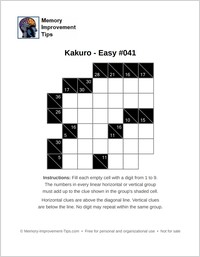
A good starting point if you're new to Kakuro. These 7×7 grids have shorter runs and smaller clue numbers, so you can focus on learning the basic logic without juggling too many combinations at once.
At this size, many runs are just two or three cells long, which means fewer possible digit combinations per clue. A two-cell run with a clue of 3 can only be 1+2. A three-cell run adding to 6 must be 1+2+3. Once you memorize a handful of these forced combinations, the Easy puzzles start to click quickly.
If you've solved Sudoku before, Kakuro will feel familiar in some ways: the no-repeat rule, the intersection logic, the process of elimination. The difference is the arithmetic layer, which gives you a different kind of foothold. Instead of scanning for plain singles, you're adding digits and asking what fits.
50 Medium Kakuro (9×9)
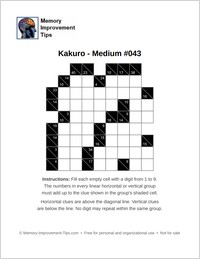
A step up in both grid size and reasoning depth. These 9×9 puzzles have longer runs and larger clue numbers, which means more possible digit combinations to consider for each clue.
You'll find that the intersection logic becomes more important at this level. Individual runs often have multiple valid combinations, so you'll need to use crossing constraints to narrow the field. Writing small candidate numbers in cells helps keep track of what's still possible.
The 9×9 grid hits a good balance: complex enough to hold your attention for 15 to 25 minutes, but compact enough that you can see how deductions in one area ripple across the grid. A solid choice for regular practice.
50 Hard Kakuro (11×11)
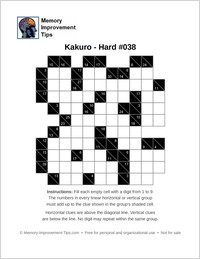
Full-size 11×11 Kakuro for experienced solvers. These grids have longer runs, larger clue numbers, and more intersecting constraints to manage. You'll encounter runs of four or five cells where several combinations are possible, and narrowing them down requires careful cross-referencing.
Pencil marks are essential at this level. Write candidate digits in each cell and cross them off as you eliminate possibilities. The payoff comes when a single deduction cascades through multiple intersecting runs, filling in a whole section at once.
Expect these to take 25 minutes or more. If you get stuck, try a different section of the grid. Often a deduction you missed in one area will unlock progress elsewhere. The solution files are there if you need to verify a tricky intersection rather than starting over.
How to Solve Kakuro
Kakuro is like a crossword puzzle with numbers. Each "word" is a run of cells that must add up to the clue number, using only digits 1-9 with no repeats within that run.
The rules:
1. Fill each white cell with a digit from 1 to 9.
2. Each horizontal or vertical run of cells must add up to the clue shown in the black cell beside or above it.
3. No digit can repeat within a single run.
Basic strategies:
Learn the key combinations. Some totals have only one possible combination. For example, a 2-cell run adding to 3 must be 1+2. A 2-cell run adding to 17 must be 8+9. Memorizing common combinations speeds up solving.
Start with the forced cells. Look for runs where only one combination works, then see where those cells intersect with other runs.
Use elimination. If a cell belongs to two runs, it must satisfy both constraints. Cross off digits that would violate either run.
Work the intersections. Cells where horizontal and vertical runs meet give you the most information. Solve these first when possible.
Printing Tips
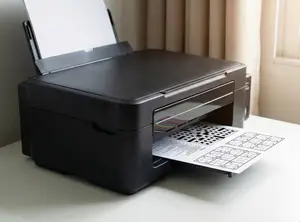
Each puzzle is a single-page PDF designed for standard letter-size (8.5×11") paper. They also print well on A4. For the best results, use your browser's "Fit to page" setting and make sure "Print backgrounds" is turned off (it should be by default). The puzzles are black and white, so they work fine on any printer.
If you're printing for a group (for example, a classroom, a company event, a senior center activity, or family game night), feel free to print as many copies as you need. The solution files are separate, so hand out puzzles without worrying about answers being visible on the back.
Prefer to solve on a tablet? The PDFs also work well with stylus-based annotation apps. Just open the file and write directly on the screen.
Why Kakuro?
Kakuro combines the logic of sudoku with simple arithmetic. It exercises working memory (holding combinations in mind), logical deduction, and pattern recognition. Many solvers find it more engaging than Sudoku because the addition element adds variety. Every puzzle has a different shape and different clue numbers, so there's no sense of repetition even after dozens of solves.
For more about the cognitive benefits of puzzles, see my Brain Games overview.
More Printable Puzzles
This page is part of my Printable Puzzles collection. I'm adding new puzzle types regularly.
You might also enjoy my Printable Sudoku, Printable Futoshiki, or Printable Slitherlink puzzle pages.
Terms of Use
These puzzles are free for personal use and for organizations, including classrooms, senior centers, memory care facilities, homeschool groups, clubs, churches, and workplaces. You may print as many copies as you need. Please don't sell them or remove the copyright notice.
Publishers: You may include one or two puzzles in each newsletter or bulletin with attribution to Memory-Improvement-Tips.com.
Published: 01/25/2026
Last Updated: 04/30/2026
Newest / Popular
Multiplayer
Board Games
Card & Tile
Concentration
Daily Games
Math / Memory
Puzzles
Time Mgmt
Word Games
- Retro Flash -
Also:
Bubble Pop
• Solitaire
• Tetris
Checkers
• Mahjong Tiles
•Typing
No sign-up or log-in needed. Just go to a game page and start playing! 

Sudoku, Kakuro, Word Searches, Crosswords, Slitherlink & more!
Hundreds of printable puzzles you can download, print, and solve with pencil and paper.

Hippocampus? Working memory? Spaced repetition?
Look up memory or brain terms in the A-Z glossary of definitions.