|
Ever learn a new vocabulary word, then forget it by the next day? Below I explain a simple trick that makes words stick in your memory. It may seem silly at first, but I find it very effective.
The email series so far:
1. Active recall • April 30
2. Spaced repetition • May 13
3. Make a picture (today)
Picture a bowl of white rice with a rose growing out of it, as in the image below. That bizarre image is how I remember the Spanish word for rice. That word is arroz, pronounced "ah-ROHS."
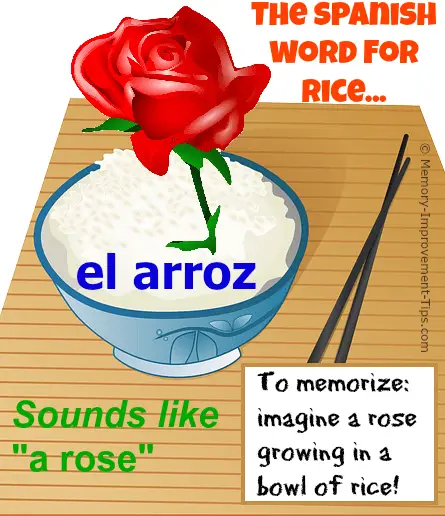 In the picture, the bowl of rice reminds me what the word means (rice), and the rose reminds me how to say it (ah-ROHS). One strange picture, and the word sticks. In the picture, the bowl of rice reminds me what the word means (rice), and the rose reminds me how to say it (ah-ROHS). One strange picture, and the word sticks.
Pretty much anyone can do this. Let me show you how it works.
First, a quick note on where this fits in this Memory Tips series. The last two issues were about how to make a memory permanent: spaced repetition using active recall.
This newsletter issue is about the step that comes before those, namely getting something into your head in a way that sticks at all.
Why pictures work so well
Some things are hard to remember. For example, a word in another language. A scientific or medical term. Or the capital of a country.
With abstract knowledge, your brain has nothing to grab onto, so facts can easily slip away. And repeating a word or fact over and over is the least effective way to remember it.
A mental picture fixes that. Your brain holds onto images far better than it holds onto plain words.
It's why you remember a face but forget the name that goes with it. Or why you can still recall a restaurant where you ate years ago, even if its name is long gone from your memory.
So turn the thing you want to remember into a picture. The stranger the better. That's because your brain skips right past boring things, but it grabs onto anything odd, bizarre, impossible, or shocking.
Look at the rice and the rose. Again, the bowl of rice tells the meaning (rice). The rose tells the sound (ah-ROHS). But you'll never find a rose growing from a bowl of rice in real life. That's why it's memorable.
Each part of the picture has a job. That's a key, too: make every part of the picture stand for something.
A second example: a bull named Gary
Here's a funny mental image for remembering a real-world fact. The fact: Sofia is the capital of Bulgaria.
 My mental picture: a bull reclining on a sofa, wearing a "Gary" name tag. There's a little propeller cap on his head. My mental picture: a bull reclining on a sofa, wearing a "Gary" name tag. There's a little propeller cap on his head.
The bull named Gary (the "Gary bull") sounds like "Bull-Gary-a" (Bulgaria). The word "sofa" he's lying on sounds like "Sofia." The cap is my reminder that Sofia is the country's capital city.
It can be helpful to quickly sketch your image on paper. You don't have to hold the image only in your head. The sketch doesn't need to be artistic or take a long time.
Drawing a sketch forces you to pin down the details, which makes the memory stronger. And you've got something to glance at later when you review.
"But I can't see pictures in my head"
Maybe that's what you're thinking right now. If so, you're not alone, and please don't quit here. This is the part where most people give up, and they don't need to.
Here's the thing. Only about 1 in 100 people truly see nothing at all in their mind. Most people who say "I can't picture things" actually have a weak mind's eye, not a blank one. They just think the trick isn't for them.
And here's the part that matters most: you don't even have to "see" the mental picture for this method to work.
Memory expert Anthony Metivier teaches memory skills for a living. He says his own mind's eye is so faint that he works with words and sounds instead of clear pictures. Metivier has spent years helping people who see nothing at all, and the trick still works for them.
So if you can't see the rose in the rice bowl in your mind's eye, just describe it to yourself in words: "a rose, growing out of a bowl of rice." Building the link is what counts. Seeing it like a mental photograph is not required.
Periodic Review: The critical step most people skip
Thinking up a mental picture is not enough. This is where the whole trick breaks down for many people. You make a great picture, you feel sure you'll never forget it, and a week later it's gone.
The creative image you make gets the fact into your head. But it still has to survive, like any memory. So bring it back, over and over.
Recall the picture the next day. Then a few days later. Then a week. Then a month.
Sound familiar? That's active recall and spaced repetition again, the two tricks from the last two issues. Now you're using them on the mental pictures you make.
That's why my bull on the sofa has stuck for years. Not because I made it once, or even because it's really memorable.
But rather because I've called it back to mind many times, and each time made it stronger. So the three tricks work as one: make a picture to learn it, then recall it over time to keep it.
When to use this technique
The mental image trick works best for words in another language, medical or technical terms, names, and facts that just won't stick. It's not as useful for things you already know well, or for hands-on skills like riding a bike, which need real practice instead.
Want more examples? The creating mental images page on my website goes deeper. It also leads into the bigger techniques built on this one, like the link method and the peg method, which I'll cover in future issues.
|