|
In the previous issue I wrote about "active recall", the simple practice of closing the book and trying to remember what you just read. It's one of the most effective memory techniques there is.
But on its own, it has a problem. You can recall something perfectly today and forget it almost entirely a week later.
This is where spaced repetition comes in. It's the other half of the equation, and the two techniques together (active recall + spaced repetition) are the closest thing memory research has to a formula for long-term retention.
Why most of what you learn disappears
Hermann Ebbinghaus discovered something unsettling in the 1880s. He tested himself on nonsense syllables and tracked how quickly he forgot them. The result was the "forgetting curve," and it's brutal.
Within 24 hours of learning something, you've typically lost 50 to 70 percent of it. Within a week, almost all of it is gone, unless you've reviewed.
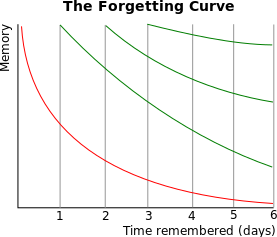
The good news is that each time you review, the forgetting curve gets flatter. The first review buys you a few days. The second review buys you a week or two.
By the fourth or fifth review, the material moves into long-term memory with only occasional reinforcement needed to keep it there.
In the graph at left, the green lines are flattened curves after repetitions. They show that after spaced review, fewer and less-frequent repetitions are needed to retain knowledge.
The catch: timing matters. Cepeda and colleagues reviewed hundreds of experiments and found that the ideal spacing depends on how long you want to remember the material.
For something you'll need next week, review within a day. For something you want to retain for a year, longer gaps work better.
A simple spaced repetition schedule
Here's a practical schedule you can use for anything you want to remember long-term:
Review 1: One day | Review 2: Three days | Review 3: One week
Review 4: Two weeks | Review 5: One month
Each review should be active recall (close the book, try to remember — then check). The combination is what makes this work. Spaced repetition without active recall is just rereading on a schedule, which isn't much better than rereading.
A few real-world ways to use it
• Learning new vocabulary: schedule reviews of new words across days, not minutes
• Courses or training: review notes one day after class, three days later, one week, two weeks, one month
• New acquaintances: actively recall their faces the morning after meeting, again two days later, again at the end of the week
• Book/reading content: take a few notes in your own words, then space your review of those notes
The technique is most powerful for facts, vocabulary, concepts, and procedures. It's less useful for physical skills (those need their own kind of practice). But for any kind of knowledge work, spaced repetition is the difference between learning something once and learning it for life.
For the full breakdown, including how to set up a spaced repetition system with flashcards or apps like Anki, see the spaced repetition page on the site.
|