- Home
- Brain Games
- Free Online Brain Games
- Matrix Typer Game
Matrix Typer Game - Play Free Online
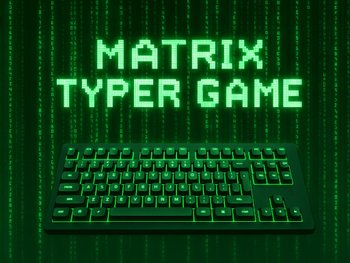
Words are falling. The clock is running. Type fast enough and they disappear. Miss too many and the system crashes. That's Matrix Typer in a nutshell: a typing game wrapped in the iconic green-on-black visual style of The Matrix, where your keyboard is your only weapon.
This game is part of the free online brain games collection on this site. For more typing games, see the Fun Typing Games page.
To begin, click the Small, Medium, or Large button under the picture of the game. This opens the game in a pop-up window.
How to Play Matrix Typer
The rules are simple. Words appear at the top of the screen and fall downward through a cascade of green Matrix-style code. Your job is to type each word correctly before it reaches the bottom. Every accurate word scored keeps the system alive. Every miss brings it one step closer to failure.
Controls. On desktop or laptop: use your physical keyboard to type the falling words. On tablet or phone: an on-screen keyboard appears automatically.
Levels. The game is structured as a progressive typing course. Early levels use simple key combinations, starting with home-row keys (A, S, D, F, G). As you advance through the stages, you unlock harder sequences that cover the full keyboard, including numbers and symbols. Each stage locks until you complete the one before it, which keeps the challenge appropriate to your current skill level.
Scoring. Speed and accuracy both matter. Type correctly and quickly to maximize your score. Sloppy typing costs you, even if you eventually get the word right.
If you enjoy this one, you might like the other free concentration games on the site as well.
Why a Typing Game is Better Brain Training Than It Sounds
Typing games tend to get lumped in with "fun distractions," but Matrix Typer is doing several cognitively demanding things at once, and the research on typing as a skill is more interesting than most people expect.
Working memory and pattern recognition. To type a falling word, you have to hold it in working memory long enough to execute the keystrokes while simultaneously scanning for the next word in the queue. That rapid cycle of encoding, holding, and acting on information is exactly the kind of task that exercises working memory. It's not abstract exercise: you're doing it under mild time pressure, which is when working memory capacity matters most in daily life.
Motor memory and automaticity. Typing is one of the clearest examples of procedural memory in everyday life. At first, finding each key is a conscious, deliberate act. With enough repetition, the finger movements become automatic: you stop thinking about where the keys are and start thinking only about what you want to type. Psychologists call this "automaticity," and it's the same process behind learning to drive, play an instrument, or throw a baseball. Matrix Typer accelerates that shift by forcing you to type under pressure, which compresses the practice reps that automaticity requires.
Sustained attention. The game demands continuous focus. There's no pause button, no forgiveness for drifting. Maintaining that level of attention for several minutes is a legitimate form of concentration practice, and the Matrix aesthetic, falling characters, pulsing code, makes it easier to stay locked in than a blank typing test would.
Reaction time. As levels increase in speed, you're also training the connection between visual input (seeing a word), cognitive processing (reading and recognizing it), and motor output (typing it). That sequence gets faster with practice, and faster reaction times have real-world value beyond the game screen.
All of this happens while you're having fun, which matters. Research consistently shows that people practice more and practice longer when the activity is enjoyable. A ten-minute session of Matrix Typer is a ten-minute session of real typing practice, and most people will happily play it again tomorrow.
Tips for Getting Better Faster
Don't watch your hands. It's tempting to look down at the keyboard, especially when the words get tricky. Resist it. Eyes on the screen, always. Looking at your hands breaks the visual feedback loop and actually slows you down. If you don't know where a key is without looking, the game will teach you: the repeated search and find builds the muscle memory you need.
Accuracy first, speed second. This is the counterintuitive truth about typing improvement: trying to go fast before you're accurate just reinforces bad habits. The speed comes naturally once accurate keystrokes are automatic. In the early levels, slow down slightly and focus on hitting every letter correctly. Your speed scores will improve on their own.
Read the whole word before you start typing. Beginning typists often read letter-by-letter as they type, which creates a choppy rhythm and causes errors. Try to take in the full word in one glance, then type it. This shifts you from a reactive, letter-by-letter mode into a more fluid, word-based mode that experienced typists use.
Use the progressive levels deliberately. The game's course structure isn't just for beginners. Even experienced typists often have weak spots on less-used keys. The later levels of Matrix Typer specifically target those gaps. If a level is harder than expected, that tells you something useful about where your muscle memory has gaps.
Short sessions, repeated often, beat long marathons. Skill memory consolidates during rest. A 10-minute session today, a 10-minute session tomorrow, and another the day after will produce more durable improvement than a 30-minute grind today and nothing for a week. This is the same principle behind spaced repetition, applied to motor learning.
Who Benefits Most from Playing?
Matrix Typer is well-suited to a wider range of players than the Matrix theme might suggest.
Students who do most of their schoolwork on a keyboard will find that faster, more accurate typing makes writing assignments less mentally exhausting, because less attention goes to the physical act of typing and more is available for actual thinking and composition.
Adults who type regularly for work, but never formally learned touch typing, often plateau at a speed that's functional but slower than it could be. This game, particularly its structured level progression, can help break through that plateau by targeting the specific key combinations that cause hesitation.
Older adults who want to keep their fingers nimble and their reaction times sharp will find this an engaging way to do it. The visual demands are manageable, the premise is clear, and the short-session structure fits easily into a daily routine.
And if you simply love The Matrix aesthetic and want an excuse to stare at falling green code for twenty minutes, that's a perfectly good reason too.
For more brain games, see the main Free Online Brain Games page or the Fun Typing Games page.
Published: 02/21/2026
Last Updated: 02/21/2026
Newest / Popular
Multiplayer
Board Games
Card & Tile
Concentration
Daily Games
Math / Memory
Puzzles
Time Mgmt
Word Games
- Retro Flash -
Also:
Bubble Pop
• Solitaire
• Tetris
Checkers
• Mahjong Tiles
•Typing
No sign-up or log-in needed. Just go to a game page and start playing! 

Sudoku, Kakuro, Word Searches, Crosswords, Slitherlink & more!
Hundreds of printable puzzles you can download, print, and solve with pencil and paper.

Hippocampus? Working memory? Spaced repetition?
Look up memory or brain terms in the A-Z glossary of definitions.