- Home
- Printable Puzzles
- Printable Sudoku Puzzles
- Hard Sudoku Printables
100 Free Hard Sudoku Printables
For a bigger challenge, I've put together 100 free hard Sudoku printables for solvers who enjoy working beyond the obvious answers. Each puzzle has one large grid per page and a separate solution. Choose any puzzle below to print it or save as a PDF. All free, no signup required.
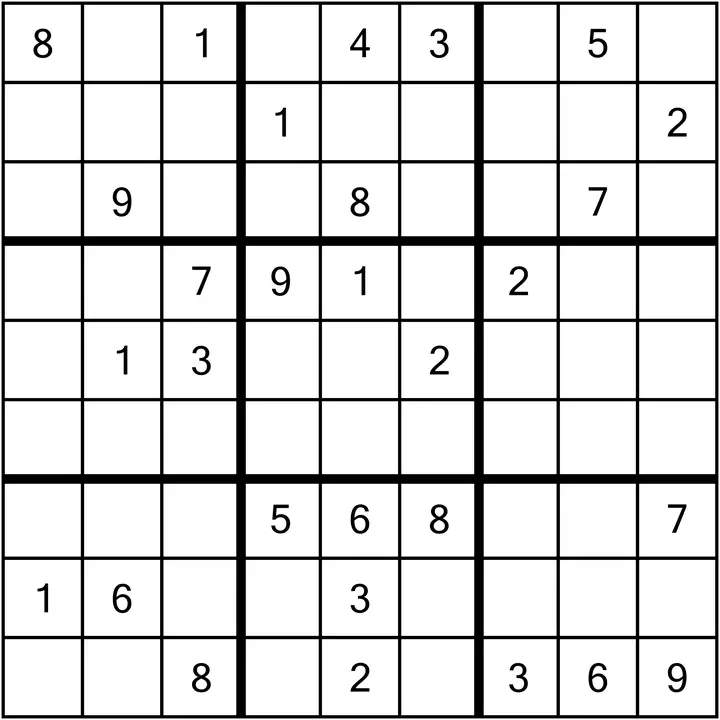

To print or save a puzzle: Select a numbered Puzzle link, then choose Print This Page. Select your printer or a PDF option in the print window. The Solution link beside each puzzle opens its matching answer key. Puzzle and solution pages open in a new tab.
Every puzzle has exactly one solution and a verified Hard rating in HoDoKu 2.2.0 using its default settings. These grids go beyond singles-only solving. Expect to use pencil marks, spot relationships between squares, and sometimes eliminate a possibility before you can place another number.
The five groups simply help you find a puzzle number; they are not a difficulty ladder. For a gentler starting point, try my Easy Sudoku Printables. For help with this collection, see how I checked the difficulty or the worked XY-Wing example from Puzzle #002.
Choose a Hard Sudoku Puzzle
Hard Sudoku Puzzles 1-20
- Puzzle #001 Solution
- Puzzle #002 Solution
- Puzzle #003 Solution
- Puzzle #004 Solution
- Puzzle #005 Solution
- Puzzle #006 Solution
- Puzzle #007 Solution
- Puzzle #008 Solution
- Puzzle #009 Solution
- Puzzle #010 Solution
- Puzzle #011 Solution
- Puzzle #012 Solution
- Puzzle #013 Solution
- Puzzle #014 Solution
- Puzzle #015 Solution
- Puzzle #016 Solution
- Puzzle #017 Solution
- Puzzle #018 Solution
- Puzzle #019 Solution
- Puzzle #020 Solution
Hard Sudoku Puzzles 21-40
- Puzzle #021 Solution
- Puzzle #022 Solution
- Puzzle #023 Solution
- Puzzle #024 Solution
- Puzzle #025 Solution
- Puzzle #026 Solution
- Puzzle #027 Solution
- Puzzle #028 Solution
- Puzzle #029 Solution
- Puzzle #030 Solution
- Puzzle #031 Solution
- Puzzle #032 Solution
- Puzzle #033 Solution
- Puzzle #034 Solution
- Puzzle #035 Solution
- Puzzle #036 Solution
- Puzzle #037 Solution
- Puzzle #038 Solution
- Puzzle #039 Solution
- Puzzle #040 Solution
Hard Sudoku Puzzles 41-60
- Puzzle #041 Solution
- Puzzle #042 Solution
- Puzzle #043 Solution
- Puzzle #044 Solution
- Puzzle #045 Solution
- Puzzle #046 Solution
- Puzzle #047 Solution
- Puzzle #048 Solution
- Puzzle #049 Solution
- Puzzle #050 Solution
- Puzzle #051 Solution
- Puzzle #052 Solution
- Puzzle #053 Solution
- Puzzle #054 Solution
- Puzzle #055 Solution
- Puzzle #056 Solution
- Puzzle #057 Solution
- Puzzle #058 Solution
- Puzzle #059 Solution
- Puzzle #060 Solution
Hard Sudoku Puzzles 61-80
- Puzzle #061 Solution
- Puzzle #062 Solution
- Puzzle #063 Solution
- Puzzle #064 Solution
- Puzzle #065 Solution
- Puzzle #066 Solution
- Puzzle #067 Solution
- Puzzle #068 Solution
- Puzzle #069 Solution
- Puzzle #070 Solution
- Puzzle #071 Solution
- Puzzle #072 Solution
- Puzzle #073 Solution
- Puzzle #074 Solution
- Puzzle #075 Solution
- Puzzle #076 Solution
- Puzzle #077 Solution
- Puzzle #078 Solution
- Puzzle #079 Solution
- Puzzle #080 Solution
Hard Sudoku Puzzles 81-100
- Puzzle #081 Solution
- Puzzle #082 Solution
- Puzzle #083 Solution
- Puzzle #084 Solution
- Puzzle #085 Solution
- Puzzle #086 Solution
- Puzzle #087 Solution
- Puzzle #088 Solution
- Puzzle #089 Solution
- Puzzle #090 Solution
- Puzzle #091 Solution
- Puzzle #092 Solution
- Puzzle #093 Solution
- Puzzle #094 Solution
- Puzzle #095 Solution
- Puzzle #096 Solution
- Puzzle #097 Solution
- Puzzle #098 Solution
- Puzzle #099 Solution
- Puzzle #100 Solution
How I Check and Rate These Hard Sudoku Puzzles
I used Cross+A and HoDoKu to generate the puzzles, then checked the entire collection against the same standard. A generator's difficulty label alone was not enough to earn a place here.
- One solution per puzzle. An independent solver checked each grid for exactly one solution and confirmed that its separate answer key matches.
- A consistent Hard rating. All 100 received a Hard rating in HoDoKu 2.2.0 with its default difficulty settings. Its five levels are Easy, Medium, Hard, Unfair, and Extreme. This collection sits in the middle category.
- More than singles. A separate check confirmed that none can be completed using only single-candidate placements and hidden singles. You will need to reason about groups of candidates or relationships between squares.
- A logical route to the answer. HoDoKu completed every puzzle without brute-force or template-search fallback. I also checked for repeated grids within this collection and against my previously checked puzzle sources.
For experienced solvers: HoDoKu's rating reflects the techniques used in its solution path and their combined score. The recorded paths in this collection include techniques such as pairs, X-Wings, XY-Wings, Skyscrapers, and W-Wings. The particular mix varies by puzzle; a technique appearing in one recorded path does not mean it is the only possible way forward.
Difficulty labels vary between publishers, and familiar patterns are easier to spot than unfamiliar ones. I keep the software version and settings fixed so that Hard means the same thing throughout this collection. The number of starting clues alone is not my difficulty test.
How to Approach a Hard Sudoku
The rules are unchanged: fill every row, column, and outlined 3 x 3 box with the numbers 1 through 9, without repeating a number. The printed starting clues stay in place. The extra challenge comes from finding which possibilities can be ruled out.
- Take the straightforward answers first. Look for a square with only one candidate, or a number with only one possible position in a row, column, or box. Hard puzzles still contain plenty of simple moves.
- Keep complete pencil marks when scanning stops working. In each empty square, note every number that still fits its row, column, and box. An omitted candidate can make a false pattern look convincing, so distinguish a complete list from a quick note about one possibility.
- Look for pairs and box-line relationships. Two squares in the same row, column, or box containing only the same two candidates reserve those numbers for those squares. If all possible positions for a number inside a box lie in one row or column, that number can be removed from the rest of that line outside the box.
- Move on to a pattern you recognize. An X-Wing connects two rows and two columns for one candidate. An XY-Wing connects three squares with two candidates each. Check every condition of the pattern before crossing anything out; the example below walks through an actual XY-Wing.
- Return to singles after each elimination. A difficult deduction may produce a very ordinary next move. Update affected pencil marks and scan again before searching for another advanced pattern.
Why crossing out one candidate counts as progress
You do not have to write a final answer at every step. Suppose two squares in a row contain only 2 and 7. You may not yet know which square takes which number, but you do know that every other square in that row must use something else. Removing a 2 or 7 elsewhere can expose a single or another useful pattern.
This is why neat pencil marks matter more on a hard grid. Work lightly in pencil, erase candidates that have been ruled out, and keep the final answers visually distinct from your notes.
Worked Example: An XY-Wing in Puzzle #002
This position comes from Hard Sudoku #002 after some singles and a pair elimination. It is a partly solved grid, not the starting puzzle. If you want to solve #002 without hints, skip this example.
Count rows from top to bottom and columns from left to right. The diagram shows pencil marks only in the four squares involved. Unmarked empty squares still have candidates; their notes are omitted to keep the example readable.
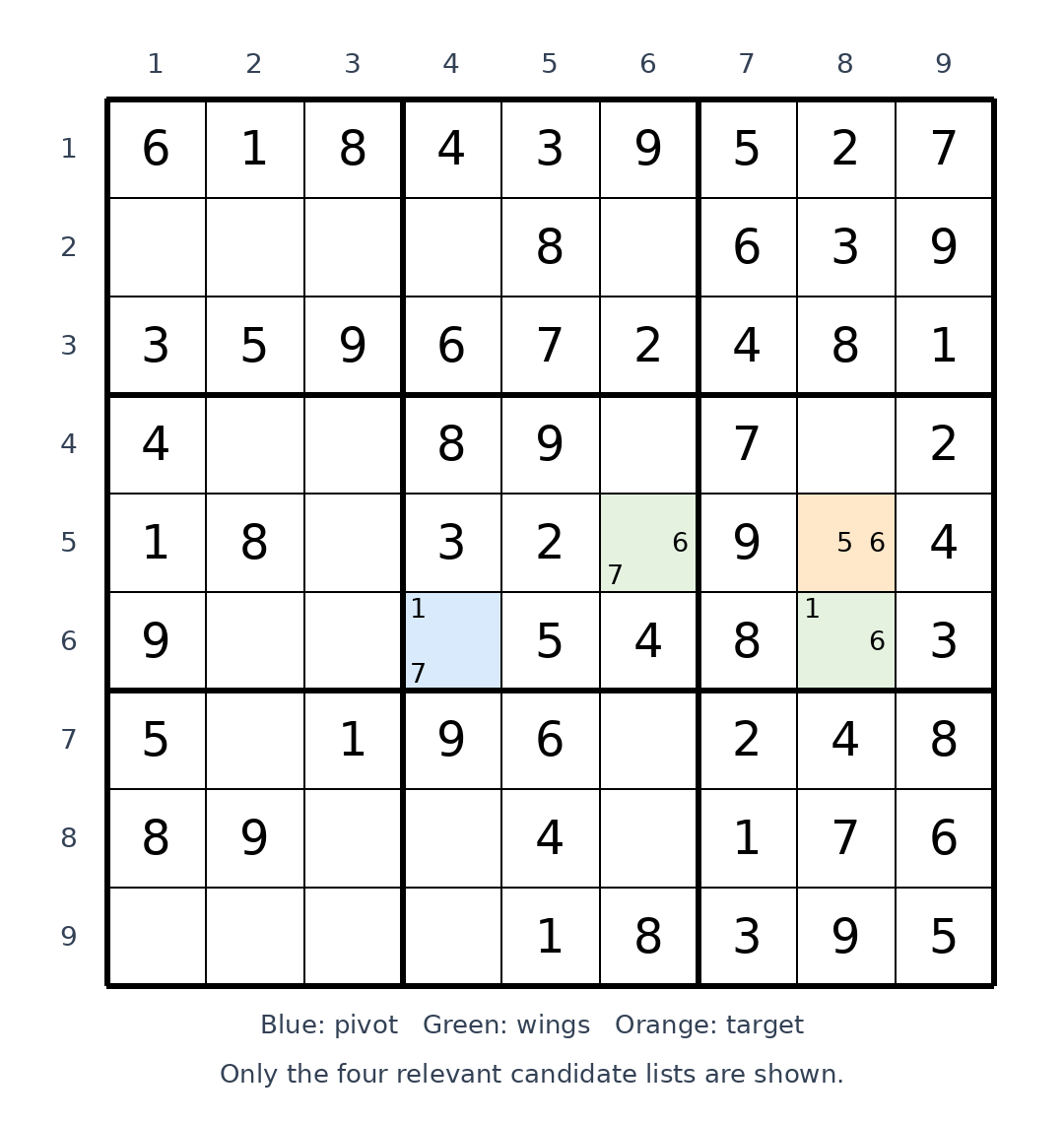
- Find the pivot. The blue square at row 6, column 4 has only two candidates: 1 and 7.
- Find its two wings. The green square at row 5, column 6 has 6 and 7 and shares the pivot's middle 3 x 3 box. The green square at row 6, column 8 has 1 and 6 and shares the pivot's row.
- Consider both possibilities for the pivot. If the pivot is 1, row 6, column 8 must be 6. If the pivot is 7, row 5, column 6 must be 6. Either way, at least one of those two wings contains a 6.
- Remove 6 from the target. The orange square at row 5, column 8 shares a row with one wing and a column with the other. It cannot be 6 in either case. Its candidates were 5 and 6, so it must be 5.
You have proved an answer without choosing a branch and guessing your way forward. An XY-Wing has three two-candidate squares, with the pivot connected to both wings; the candidate shared by the wings can be removed from any square that shares a row, column, or box with both wings.
For more examples, see HoDoKu's illustrated XY-Wing guide. The separate solution for #002 is available when you want to check the finished grid.
What to Do When You Get Stuck
First, check the pencil marks around your latest answers. A newly placed number may remove a candidate from a square several cells away. Then scan one number across the whole grid, looking for places where its remaining positions line up.

If a pattern feels almost right, check its conditions rather than stretching the rule. Two squares that both include 3 and 8 are not a pair if one also includes 5. Similarly, a target square in an XY-Wing must connect to both wings, not just the pivot.
If a square has no candidates, or a row, column, or box repeats a number, revisit your recent entries and eliminations. A wrong pencil-mark deletion can cause trouble several moves later. Taking a break or switching to another numbered puzzle is perfectly reasonable.
I keep the answer keys separate so you can choose how much help to use. Check one square if you need a nudge, or compare the whole grid after finishing. For a refresher on the basic rules and scanning, see Kevin Rush's Sudoku Instructions: How to Play and Win here on my site.
Printing Hard Sudoku or Saving It as a PDF
Open a numbered Puzzle link before printing. Each printable sheet has one 5.5-inch grid, giving you room for pencil marks. The matching Solution link opens a separate sheet with the same puzzle number.
- For a paper copy: Choose Print This Page, select your printer, and check the preview. Use portrait orientation. The sheet is designed for US Letter paper; for A4 or a clipped edge, choose your print window's fit-to-page setting.
- For a PDF copy: Select the PDF destination in the same print window, often called Save as PDF or Microsoft Print to PDF. Save the puzzle and its solution separately, retaining the three-digit number in both filenames.
- For a clean sheet: Turn off the print window's headers and footers if it adds a date, URL, or page number. The page's ads and navigation are excluded from the printable sheet.
- To print several puzzles: Use Next Hard Sudoku Puzzle above the preview to advance in order. The same link is on each solution page, so you can print a puzzle, print its answer key, and then go straight to the next puzzle. Puzzle #100 and its solution return to this hub.
For smaller grids and fewer sheets, try my four-puzzles-per-page Sudoku collection, which has several difficulty levels.
Common Questions
Are these hard Sudoku puzzles and answers free?
Yes. All 100 puzzles and their separate solutions are free to print or save as PDFs. You do not need an account, email signup, or payment.
Which puzzle should I start with?
Choose any number. The groups are for navigation, and #100 is not necessarily harder than #001. Try #002 if you would like to compare part of your solve with the worked example above. If you are still learning the rules, start with my Easy Sudoku Printables.
Do hard Sudoku puzzles require guessing?
These puzzles have verified logical solution paths, so guessing is not required. You may need a technique you have not learned yet. Finding a contradiction after trying a number is different from the pattern-based reasoning illustrated above.
Are these the same as expert or very hard Sudoku?
Publishers use those labels differently. This collection specifically uses HoDoKu's default Hard category; puzzles rated Unfair or Extreme were excluded. A familiar technique may make one puzzle feel easier than another with the same rating.
Can I download all 100 as one PDF?
This collection is organized as individual puzzle and solution pages. Use the PDF option in the print window to save the ones you want. The Next Puzzle link makes it easy to work through several in sequence.
May I copy or share these puzzles?
Yes. You may print and share copies for home, classroom, church, club, workplace, care-home, or activity-group use. Keep the copyright line in place, and do not sell the puzzles. You may also include a puzzle in a newsletter or other publication with this credit: "© Memory-Improvement-Tips.com. Reprinted by Permission."
More Free Sudoku and Printable Puzzles
For a relaxed warm-up, visit my 100 Easy Sudoku Printables. My 150 Printable Sudoku Puzzles collection includes Easy, Medium, and Hard levels, while 100 Large Sudoku Printables also includes Very Hard puzzles.
For a change of pace, try my Printable Crossword Puzzles, Word Searches for Adults, or Large Print Word Searches. You can find all the collections in my Printable Puzzles directory.
Published: 10/10/2026
Last Updated: 10/10/2026
Newest / Popular
Multiplayer
Board Games
Card & Tile
Concentration
Daily Games
Math / Memory
Puzzles
Time Mgmt
Word Games
- Retro Flash -
Also:
Bubble Pop
• Solitaire
• Tetris
Checkers
• Mahjong Tiles
•Typing
No sign-up or log-in needed. Just go to a game page and start playing! 

Sudoku, Kakuro, Word Searches, Crosswords, Slitherlink & more!
Hundreds of printable puzzles you can download, print, and solve with pencil and paper.

Hippocampus? Working memory? Spaced repetition?
Look up memory or brain terms in the A-Z glossary of definitions.