- Home
- Memory Skills
- Memory Palace
- Memorize a List
How to Memorize a List Using the Memory Palace
You can memorize the seven Harry Potter book titles in order, or the eight essential parts of a desktop computer, in about ten minutes, and recall them days later without looking at a single note. The method is the Memory Palace, the same technique used by memory champions to memorize hundreds of items in competition.
But you don't need to be a memory athlete or have any prior experience with memory techniques. You just need a place you know well and a willingness to picture some strange things.
The Memory Palace (also called the Method of Loci) works like this: you mentally walk through a familiar location and place a vivid image at each spot along the way. To recall the list, you retrace your route, and the images are waiting for you, in order.
For the full technique, see my complete guide to the Memory Palace. On this page, I'll walk you through two real examples so you can see it in action.
Setting Up Your Route

Before you place any images, you need a clean route through your space. Here's what I've learned from years of practice:
Stand at the entrance looking in. Picture yourself at the doorway of the room or the front of the building. This is your vantage point, not your first station.
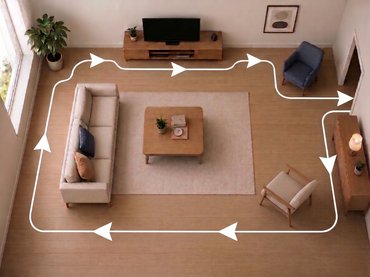
The first station is the first landmark you see inside, to the right or left. You sweep around the room from there, and the door itself becomes your last station, completing the loop.
Pick a direction and stick with it. Sweep clockwise or counterclockwise around the space. Don't bounce from one side to the other, because a zigzag path is harder to retrace from memory. The route should feel like a natural walk through the room, not a scavenger hunt.
Use landmarks that are visually distinct from each other. A door, a window, a couch, a bookshelf, a table. Each station needs to be clearly different from the ones next to it, so your images don't blur together.
You don't need to visit a place dozens of times. When you're starting out, use spaces you already know well, like your own home.
But with a little practice, you'll find that one calm, attentive walkthrough of a new space is enough. Visit a museum, walk through a restaurant for the first time, tour a friend's house, and if you simply look around and note where the distinct features are, you have a usable palace.
The key isn't repetition, it's attentiveness. If you paid attention while you were there, you can use it.
Most palaces are rooms: your bedroom, your office, a restaurant you visit often. In my experience, indoor locations work best, because walls delimit the route. You have a clear boundary, and the furniture and features along those walls give you natural stations in sequence.
Outdoor spaces can work too (a public park with a parking lot, a fountain, flower beds, a pond, and a restroom building gives you five or six easy stations), but outdoor routes tend to be more linear or chaotic, which makes them harder to retrace reliably. I've even used the interior of my car in a pinch, though rooms remain my default.
And don't overlook corners. Even a completely empty room works as a memory palace. Stand in the doorway looking in: the first corner is to your right. Sweep counterclockwise: second corner, third corner, fourth corner, and back to the doorway. That's five stations with no furniture required. Any room, anywhere.
One more tip: the best routes loop back to where you started. If you begin at the doorway and sweep all the way around (clockwise or counterclockwise), the door itself becomes your last station. That way you automatically know when you've finished the sequence. There's a built-in sense of completion.
For longer lists, you can chain rooms together: the kitchen flows into the living room, which flows into the hallway, and so on. Each room is a segment of the route, and you walk through them in a fixed sequence. But start with a single room. That's all you need for most lists.
Example 1: The Seven Harry Potter Book Titles (In a McDonald's)
Let's say you want to know the Harry Potter titles in order, not from a cheat sheet, but from memory. Maybe you're a fan. Maybe you just want to hold your own in a conversation.
I chose these titles because the distinguishing words are mostly concrete nouns that are easy to picture, which makes them ideal for demonstrating the method. Either way, there are seven:
- Harry Potter and the Sorcerer's Stone
- Harry Potter and the Chamber of Secrets
- Harry Potter and the Prisoner of Azkaban
- Harry Potter and the Goblet of Fire
- Harry Potter and the Order of the Phoenix
- Harry Potter and the Half-Blood Prince
- Harry Potter and the Deathly Hallows
Every title starts with "Harry Potter and the..." so the distinguishing part is the subtitle. That's what we need images for. And since these subtitles are mostly concrete (a stone, a chamber, a prisoner, a goblet, a phoenix, a prince, hallows), they're naturally easy to picture.
For the palace, I'm using a McDonald's in my neighborhood that I know well. If you're just starting out, pick a location you've been to many times, any restaurant, store, or building where you can mentally walk from spot to spot without hesitation.
Here's my route through the McDonald's, with seven stations. I stand at the front entrance looking in, and my first station is the order counter to the right:
Station 1 (Order counter): Sorcerer's Stone. A glowing, pulsing stone is sitting on the counter where you'd normally place your order. It's so bright the cashier is shielding her eyes. She tries to scan it and the register sparks.
Station 2 (Drink fountain): Chamber of Secrets. The drink fountain has split open, revealing a dark hidden chamber underneath. You can hear echoing whispers rising from below. Nobody else seems to notice.
Station 3 (Booth seating area): Prisoner of Azkaban. A gaunt prisoner in ragged robes is chained to the booth, desperately reaching for someone's abandoned fries. The more absurd the image, the better it sticks.
Station 4 (Restroom hallway): Goblet of Fire. A massive golden goblet is blocking the hallway, flames roaring out of the top and scorching the ceiling tiles. You can feel the heat from ten feet away.
Station 5 (Kitchen window/pickup area): Order of the Phoenix. A blazing phoenix is perched on the pickup counter, wings spread, screeching. Flames lick the order screens. Workers are ducking.
Station 6 (Trash/tray return): Half-Blood Prince. A regal prince in a crown is standing at the trash and tray return, but the left side of his face and robes are streaked with dark blood. He's calmly emptying his tray of half-eaten food into the bin.
Station 7 (Front entrance/door): Deathly Hallows. The triangular Deathly Hallows symbol is etched into the glass entrance door, glowing faintly. A skeletal hand reaches through from outside. You've looped back to where you started.
That's it. Seven stations, seven images. Now close your eyes and mentally walk back through: counter (glowing stone), drink fountain (hidden chamber), booth (chained prisoner), hallway (flaming goblet), pickup window (phoenix), trash return (bloody prince), front door (skeletal hand, glowing symbol). Notice how the route ends where you began.
There's a deeper reason this technique works. To create each of those images, you had to actually think about what "Goblet of Fire" or "Prisoner of Azkaban" means and picture it deliberately. That forced engagement is what memory experts call Original Awareness, and it's the real reason the Memory Palace succeeds where most study methods fail.
Most forgetting happens because information never truly registered in the first place. The Memory Palace solves that by making you construct something vivid and specific for every single item. You can't place a prisoner at a booth without paying attention to both the prisoner and the booth.
Now try it yourself. Use your own home. Stand in the doorway of your living room or kitchen, pick a direction, and identify seven stations along a sweep of the room: the door, a window, a couch, a bookshelf, a TV, a table, a lamp, whatever stands out.
Place the same seven titles at each station using your own images. You'll likely find that your images are different from mine, and that's exactly right. The technique works because the images are personal.
Add a Person and the Image Gets Even Stickier
Here's something that makes these images dramatically more memorable: put a famous person in the scene. Your brain is wired to remember people, especially faces and names you already know well. Adding a recognizable person to a station gives your memory one more hook to grab onto.
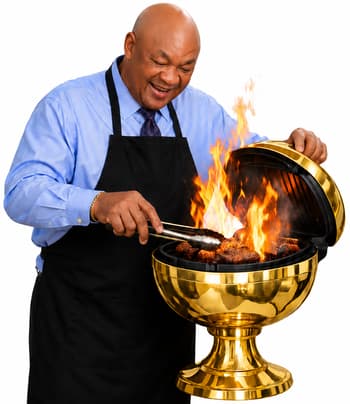
George Foreman (G.F.) grilling on the
Goblet of Fire (G.F.)
There are several ways to find the right person for each item:
Name similarity. Sorcerer's Stone makes me think of Sharon Stone. Now she's at the order counter, holding the glowing stone over her head like a trophy. That's three hooks in one image: the person, the object, and the location.
Initials. Goblet of Fire: G.F. George Foreman, the boxer. Now he's in the restroom hallway, grilling something on a golden goblet-shaped Foreman Grill while flames shoot out of it. The initials led me to the person, and the person made the image unforgettable.
Sound-alikes. Order of the Phoenix? Joaquin Phoenix practically names himself. And "order" sounds a bit like "odor," so now I picture a disheveled Joaquin Phoenix at the pickup counter, looking intense and slightly smelly, with a blazing phoenix perched on his shoulder.
You don't need a person at every station. But when one comes to mind easily, use it. The combination of a person, an object, and a location creates a web of connections that's very hard to lose. Even if one thread fades, the others pull the memory back.
Example 2: Parts of a Desktop Computer (In a Bedroom)
Here's a completely different kind of list. Say you're studying for an IT certification, or you want to build your first computer and need to know the essential components. The core parts of a desktop computer are:
- Case
- Power supply
- Motherboard
- CPU (processor)
- RAM (memory modules)
- Storage drive (SSD or hard drive)
- Graphics card (GPU)
- Cooling fans
This time I'm using a bedroom, and I want to show you the route discipline in action. I stand in the doorway looking in and sweep counterclockwise around the perimeter, starting with the dresser to the right.
From there: the window further along the right wall, the desk along the back wall, the bookshelf in the back-left corner, the closet on the left wall, the bed against the left wall closer to the door, the nightstand between the bed and the door, and finally the door itself. Eight stations along the walls, eight items, one clean loop ending where I began.
Station 1 (Dresser): Case. The dresser drawers are all popped open, revealing wires and circuit boards inside instead of clothes. It looks like someone cracked open a computer case. Sparks fly when I push a drawer shut.
Station 2 (Window): Power supply. Bolts of electricity are arcing across the window frame like a Tesla coil, lighting up the glass. I can hear the crackling and feel the static from across the room.
Station 3 (Desk): Motherboard. The desk surface has been replaced by a giant green circuit board, traces and chips everywhere. Everything connects to the desk, just like everything connects to the motherboard.

C-3PO nervously reorganizing the bookshelf
Station 4 (Bookshelf): CPU. C-3PO from Star Wars is standing at the bookshelf, nervously reorganizing books with his gold fingers. C-3PO... CPU. The sound similarity is the hook. This is called a substitute word: when something is hard to visualize directly, you substitute a vivid image that sounds similar.
Station 5 (Closet door): RAM. I open the closet and a bighorn ram charges out, scattering clothes and hangers everywhere. RAM gives the computer its working speed, and the ram just demolished the closet. Hard to forget.
Station 6 (Bed): Storage drive. The bed is buried under thousands of tiny files and folders, piled up where the blankets should be. The bed stores you at night. The storage drive stores your data. Simple connection.
Station 7 (Nightstand): Graphics card. The nightstand lamp has been replaced by a screen showing a vivid, high-definition video game scene. A graphics card handles visual output, and the lamp is now the most visual thing in the room.
Station 8 (Door): Cooling fans. Three enormous fans are mounted on the bedroom door, spinning so fast that papers fly everywhere and the room is freezing cold. The door rattles on its hinges. I'm back where I started.
Walk through it: dresser (case popping open), window (electricity arcing), desk (circuit board), bookshelf (C-3PO organizing), closet (ram charging out), bed (files piled up), nightstand (video game lamp), door (fans blasting). The route ends at the doorway where you began.
Notice the route: a clean counterclockwise sweep from the first landmark inside the door all the way around and back. No bouncing across the room, no retracing steps. That consistency is what makes the path easy to walk through from memory every time.
Two completely different lists. Two completely different locations. Same technique.
Make It Stick: A Quick Review Schedule
Placing items in your palace creates a strong initial memory, but it will fade without reinforcement. This is where most people make their only real mistake with the technique: they assume that because recall feels easy right after encoding, it will stay that way. It won't, unless you review.
Here's a simple schedule that works:
Immediately after: Walk through your palace one more time, right after placing all the images. This takes about a minute and significantly strengthens the encoding.
One hour later: Close your eyes and walk the route again from memory. If any image is fuzzy, look at your original list to refresh it, then re-visualize that station.
The next day: Run through it again. By now, most images should come back easily. Any that don't, reinforce.
After three days: Another review. At this point, the memories are consolidating.
After one week: One more pass. If everything comes back cleanly, the list is yours for the long term.
This approach is called spaced repetition, and decades of research confirm it produces far stronger retention than cramming all your practice into one session. The active recall component, retrieving the information from memory rather than passively re-reading it, is what does the heavy lifting. Each time you successfully recall the list, the memory gets stronger.[2]
The total review time across all those sessions is probably ten minutes. That's a small investment for information you can recall months later.
Common Mistakes (And What to Expect)
Vague images. This is the most common reason recall fails, and it helps to understand why. Your route is stable. The chair really is to the right of the door, the window really is on the far wall. Those landmarks aren't going anywhere, so the route almost recreates itself in your mind.
But the images you place at each station are generated from your imagination, and imagination is ephemeral. If the image wasn't vivid when you created it, it will fade fast. That's why this matters more than anything else in the technique.
"A stone near the door" is forgettable. "A blindingly bright, warm stone wedged in the door handle so I have to reach around it" is not. If an image feels weak, exaggerate it.
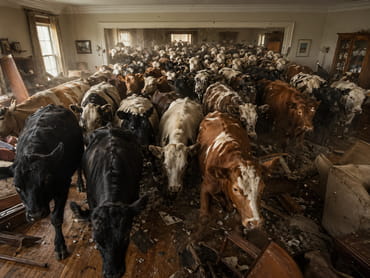
100 cows stampeding through a room
Make objects enormous or impossibly tiny. Crank up the color. Multiply them: not one cow, but a hundred cows stampeding through the room. Add sound, add smell, add dramatic or even shocking action.
The brain remembers the unusual; the ordinary is quickly forgotten. In Moonwalking with Einstein, journalist Joshua Foer describes how he trained for and won the U.S. Memory Championship by creating images that were deliberately outrageous, even uncomfortably so.
The more shocking the mental picture, the more easily he recalled the associated fact. You don't have to tell anyone your images, so make them as weird and vivid as you need to.
Rushing through placement. Take two or three seconds at each station to really see the image. This isn't a speed exercise. Those few extra seconds of deliberate visualization are the difference between a memory that lasts and one that evaporates.
Using a location you don't know well. If you have to think about what comes next on your route, your brain is working on two problems at once. Pick somewhere you could walk through blindfolded. Your home, your workplace, a store you visit every week.
Thinking it's "one and done." As the review schedule above makes clear, even well-placed images fade without reinforcement. The palace handles encoding. Spaced repetition handles retention. You need both.
Expecting photographic recall on the first try. The first time you use this technique, some images might be fuzzy or out of order. That's completely normal. With practice, the images get sharper, the placement gets faster, and the recall gets more reliable. Most people are surprised by how well it works even on their very first attempt, but it does get better.
Thinking you need a vivid visual imagination. You don't. Memory expert Anthony Metivier, who has taught the Memory Palace technique to thousands of students, has written that his best results don't come from streaming high-definition images in his head.
What matters is the sense of the object at the location, the conceptual and multi-sensory association, not a photorealistic mental picture. If you can think "ram crashing into bookshelf" and feel the impact of that idea, it works, even if your mental image is more like a sketch than a photograph.
Where to Go From Here
What you've just learned is the core of one of the most powerful memorization techniques that exists. Memory competitors, medical students, and language learners all use variations of exactly this process.[1]
If you want to understand the technique more deeply, including how to build multiple palaces, handle abstract information, and scale to hundreds of items, see my full guide to the Memory Palace.
If the "substitute word" idea (like C-3PO for CPU) intrigued you, that's the foundation of Visualization and Association, the core skill underlying all the memory systems.
If you'd rather retrieve items by number instead of walking a route, the peg system offers a different approach to the same problem: see the Peg System for Remembering Lists.
And if you noticed that paying close attention was half the battle, you're exactly right. Attentiveness is the foundation everything else rests on. The Memory Palace works partly because it forces you to be attentive, but building your baseline attention makes every technique work better.
These techniques have centuries of history behind them, but they aren't taught in school, so they might feel strange at first. That's normal. Give it a few honest tries before deciding whether it works for you. It almost certainly will.
Here's your first assignment: pick a list of five to seven items you actually want to remember. Not a grocery list. Something with lasting value: chapter topics for an exam, the steps of a process at work, titles in a book series.
Choose one room you know well, identify five to seven stations in order, and place your images. Review the route once after you finish, once more before bed, and again tomorrow morning. That's it. You'll have the list.
References & Research
1. Dresler, M. et al. (2017). "Mnemonic Training Reshapes Brain Networks to Support Superior Memory." Neuron, 93(5), 1227-1235.e6. Free full text at PMC
Researcher's Note: This landmark study scanned the brains of 23 world memory champions and found they didn't have structurally different brains. Instead, they showed distinctive patterns of functional connectivity, particularly involving the hippocampus and regions associated with spatial and visual processing. After just six weeks of memory palace training (30 minutes per day), previously untrained participants showed similar connectivity changes and could recall significantly more words. This is the strongest neuroimaging evidence that memory palace training changes functional connectivity patterns in the brain, and that the ability is trainable, not innate.
2. Cepeda, N. J. et al. (2006). "Distributed Practice in Verbal Recall Tasks: A Review and Quantitative Synthesis." Psychological Bulletin, 132(3), 354-380. ResearchGate
Researcher's Note: This meta-analysis examined 839 assessments of distributed practice across 317 experiments in 184 articles. It established that distributing study sessions across multiple time points produces substantially better long-term retention than concentrating the same total practice into one session. The optimal spacing between sessions depends on how long you need to retain the information: longer retention intervals call for longer gaps between reviews. This is the research backbone behind the spaced review schedule recommended above.
Published: 04/14/2026
Last Updated: 04/14/2026
Newest / Popular
Multiplayer
Board Games
Card & Tile
Concentration
Daily Games
Math / Memory
Puzzles
Time Mgmt
Word Games
- Retro Flash -
Also:
Bubble Pop
• Solitaire
• Tetris
Checkers
• Mahjong Tiles
•Typing
No sign-up or log-in needed. Just go to a game page and start playing! 

Sudoku, Kakuro, Word Searches, Crosswords, Slitherlink & more!
Hundreds of printable puzzles you can download, print, and solve with pencil and paper.

Hippocampus? Working memory? Spaced repetition?
Look up memory or brain terms in the A-Z glossary of definitions.