- Home
- Brain Games
- Free Online Brain Games
- Daily Wordler Game
Daily Wordler Game - Play Free Online
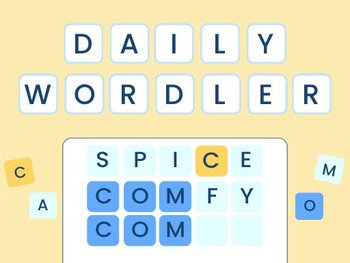
Wordle changed the way millions of people start their morning. One word, six guesses, five minutes of focused thinking before the day takes over. Daily Wordler brings that same format here, free and with no account required. Each day there's a new five-letter word to figure out, and the only tools you get are logic, your vocabulary, and a handful of color-coded clues.
If you've never tried a Wordle-style game before, you'll pick it up in about thirty seconds. If you have, you already know how satisfying it feels to crack the word in three guesses.
To begin, click the Small, Medium, or Large button under the picture of the game. This opens the game in a pop-up window.
How to Play Daily Wordler
This game is part of the Free Online Brain Games collection. For more language-based challenges, visit the Free Word Games page.
Type any valid five-letter word and press Enter to submit your guess. The game gives you feedback through color:
Blue means the letter is correct and in the right position. That letter is locked in.
Yellow means the letter is in the hidden word but you've placed it in the wrong spot. It needs to move.
Gray means the letter isn't in the word at all. Cross it off your mental list.
You have six attempts to identify the word. Each guess must be a real five-letter word. After you submit a guess, use the color feedback to narrow your options and refine the next attempt. The game resets daily with a brand new word.
What Daily Wordler Does for Your Brain
Word-guessing games look simple on the surface. Type a word, check some colors, try again. But what's actually happening between your ears during those six guesses is more demanding than it appears.
Vocabulary retrieval under constraint. This isn't just "think of a word." It's "think of a five-letter word that contains an E in the third position, has no A, and includes an R somewhere." That kind of constrained retrieval, pulling the right word from memory while satisfying multiple conditions at once, exercises a different circuit than simply recalling a word's meaning. You're searching your mental dictionary with a filter applied, and that filter changes with every guess.
Deductive reasoning. Every guess generates new information, and good players use all of it systematically. If the S is gray, every word with an S is eliminated. If the T is yellow in position one, it belongs somewhere in positions two through five. Tracking these constraints across multiple guesses and applying them simultaneously is genuine logical deduction, the same thinking pattern used in diagnostic reasoning and troubleshooting.
Working memory. By your fourth guess, you're juggling confirmed letters, eliminated letters, positional constraints, and a shrinking pool of candidate words. Holding all of that information in mind while generating your next attempt puts real demand on working memory. There's no scratchpad in the game. Your brain is the scratchpad.
Pattern recognition. English has predictable letter patterns. Experienced players start recognizing which letter combinations are common in certain positions: words ending in "-IGHT," "-OUND," or "-ATCH," for instance. Over time, you build an intuitive sense for English word structure that makes each puzzle a little easier to crack. That pattern awareness carries over into reading speed and spelling.
Strategy Tips
Start with a vowel-rich word. Your first guess should reveal as much information as possible. Words like RAISE, AUDIO, or STARE contain common letters and help you quickly identify which vowels and consonants are in play. Avoid starting with obscure words. The goal of guess one is information, not a lucky solve.
Use your second guess to cover new ground. If your first word was RAISE, don't guess RATES. You're repeating four letters and learning almost nothing new. Pick a second word that tests entirely different letters. Between two well-chosen guesses, you can test ten of the twenty-six letters in the alphabet. That's a huge advantage heading into guess three.
Pay attention to what's missing. Gray letters are just as valuable as blue and yellow ones. Every eliminated letter shrinks the pool of possible answers. Players who track eliminations carefully often solve the puzzle faster than those who focus only on confirmed letters.
Think about letter position, not just letter presence. A yellow E tells you the word contains an E, but it also tells you exactly where the E doesn't go. Both pieces of information matter. When you're stuck between two candidate words, the positional constraints often make the decision for you.
Watch for double letters. One of the trickier aspects of Wordle-style games is that the answer can contain the same letter twice, like KNEEL or TEETH. If a letter shows blue in one spot but gray in another, that usually means it appears exactly once. But if you're stuck and nothing seems to fit, consider whether a repeated letter might be the missing piece.
Don't panic on guess five. If you're on your fifth attempt and still narrowing it down, slow down. You have two guesses left. Take a breath, review everything you know (blues, yellows, grays), and make a deliberate choice. Rushed guesses waste attempts. Calculated ones close the deal.
For more games like this one, visit the Free Online Brain Games directory. For more language-based challenges, check out the Free Word Games page.
Published: 03/30/2026
Last Updated: 03/30/2026
Newest / Popular
Multiplayer
Board Games
Card & Tile
Concentration
Daily Games
Math / Memory
Puzzles
Time Mgmt
Word Games
- Retro Flash -
Also:
Bubble Pop
• Solitaire
• Tetris
Checkers
• Mahjong Tiles
•Typing
No sign-up or log-in needed. Just go to a game page and start playing! 

Sudoku, Kakuro, Word Searches, Crosswords, Slitherlink & more!
Hundreds of printable puzzles you can download, print, and solve with pencil and paper.

Hippocampus? Working memory? Spaced repetition?
Look up memory or brain terms in the A-Z glossary of definitions.