- Home
- Brain Games
- Free Online Brain Games
- Daily Jewels Blitz Mahjong
Daily Jewels Blitz Mahjong - Play Free Online

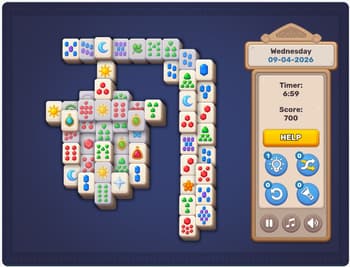
Traditional mahjong solitaire uses tiles decorated with Chinese characters, bamboo sticks, and circle patterns that have looked essentially the same for centuries. Daily Jewels Blitz Mahjong swaps all of that for colorful gemstones: rubies, sapphires, emeralds, suns, moons, and jeweled pendants arranged on a fresh layout every day.
The result is a game that plays by the same rules but asks your eyes and brain to work in a noticeably different way.
To begin, click the Small, Medium, or Large button under the picture of the game. This opens the game in a pop-up window.
How to Play Daily Jewels Blitz Mahjong
This game is part of the Free Daily Games collection. For more tile-matching games, visit the Card & Tile Games page.
Where classic mahjong tiles rely on distinct symbols, these jewel tiles force you to distinguish between gems that share the same color family but differ in shape, count, or arrangement. A tile with three small green triangles is not the same as a tile with a single green emerald pendant, even though both register as "green" at first glance. That added visual ambiguity makes the scanning process more engaging and, honestly, a bit more challenging than it first appears.
The objective is the same as any mahjong solitaire game: clear every tile from the board by matching them in identical pairs. Click one tile, click its match, and both are removed. The goal is to empty the board completely before time runs out.
A tile can only be selected if it's "free," meaning at least one side (left or right) is not blocked by another tile, and no tile is stacked on top of it. Playable tiles appear brighter than locked ones, which helps you focus your attention on what's actually available.
You have eight minutes per daily puzzle. That's a generous window, but some of the later layouts get dense, so don't assume you'll always finish with time to spare.
Boosters. Four tools appear on the right side of the game screen. Hint (lightbulb) highlights a valid matching pair. Shuffle rearranges the remaining tiles if no matches are available or you're stuck. Undo reverses your last move if you realize you've made a mistake. Torch illuminates all currently free tiles on the board. Each booster has a limited number of uses per puzzle, and you earn additional uses by maintaining your daily streak.
Streaks and rewards. The game tracks whether you complete each day's puzzle. String together consecutive days and you'll earn booster refills and other rewards. Miss a day and there's a rare chance to recover it, but the streak system is designed to reward consistency. Your longest streak is recorded, giving you a personal benchmark to beat.
Pause, music, and sound. Three controls sit at the bottom of the side panel. The Pause button stops the timer if you need to step away. The Music toggle lets you turn the background soundtrack on or off. The Sound button mutes or unmutes the tile-matching effects. Adjust these to suit your preference.
A note on the date display. The in-game calendar uses European date format (DD-MM-YYYY), so April 9th, 2026 would display as 09-04-2026. If the date looks wrong at first glance, that's why. The day and month are simply reversed from the U.S. format.
What This Game Does for Your Brain
Mahjong solitaire has been the subject of more cognitive research than most casual games. A 2024 review examined over fifty studies on mahjong and mental function in older adults, and the consistent finding was that regular mahjong play was linked to stronger cognitive, psychological, and functional abilities across multiple domains.
The Card & Tile Games page covers that research in depth. Here's what's happening cognitively each time you sit down with this jewel-themed version.
Color discrimination and visual grouping. This is where Jewels Blitz Mahjong differs most from traditional versions. Classic mahjong tiles use high-contrast symbols (a character is either a "3" or a "7," and there's no confusing them). Jewel tiles, on the other hand, cluster by color. You'll see several tiles that all look "red" at a glance, but some have three small rubies, others have a single large gem, and others have a red pendant with a gold setting.
Your visual system has to push past the initial color grouping and focus on the finer details of shape, count, and arrangement. That kind of precise visual discrimination is the same skill you use when comparing similar items on a shelf, reading a complex dashboard, or spotting a subtle difference in a document.
Planning and sequencing. Every tile you remove changes what becomes available next. Remove the wrong pair and you might strand a tile you need later, buried under layers with no matching partner in reach. Skilled players develop a habit of looking one or two moves ahead before clicking: "If I take these two sun tiles now, the moon tile underneath becomes free, and its match is sitting on the right edge."
That kind of if-then planning, carried out under a time constraint, exercises the same prefrontal circuits you rely on for everyday problem-solving and decision-making.
Sustained attention and visual search. An eight-minute timer might sound relaxed, but maintaining focused attention across a board of sixty or more tiles for that duration is genuine cognitive work. You're conducting a visual search over and over: scanning the board, identifying free tiles, checking for matches, evaluating which match to prioritize.
Each cycle requires you to filter out irrelevant information (locked tiles, tiles you've already assessed) and zero in on what matters. That repeated scan-and-filter process builds the kind of sustained attention that helps with any task requiring prolonged focus.
Spatial reasoning in layers. The tiles aren't flat. They're stacked in overlapping layers, and removing a surface tile reveals what's hidden underneath. To play well, you need a mental model of the three-dimensional structure: which tiles are covering which, and how clearing one area might open up another.
Building and updating that kind of spatial map in your head is a skill that doesn't get much practice in everyday life, which is one of the reasons tile-stacking games like mahjong are such effective cognitive exercise.
Working memory under time pressure. As you play, you're holding multiple pieces of information in mind simultaneously: the location of a tile you spotted a moment ago, the pair you're planning to match next, the tiles you need to uncover to reach a deeper layer, and the ticking clock. Juggling all of that without writing anything down puts genuine demand on working memory, the mental workspace where you hold and manipulate information in real time.
Strategy Tips
Look before you click. Before making your first match, take ten seconds to survey the full board. Notice where tiles are stacked highest, where the layout is widest, and where bottlenecks might form. That brief overview gives you a roadmap that prevents blind alleys later.
Clear the peaks first. Tiles sitting on top of other tiles are blocking the most potential matches. Prioritize removing them early to open up the layers beneath. If you focus too much on easy edge pairs at the base level, the stacked center can become an unsolvable tangle.
Don't match on autopilot. Just because two tiles match doesn't mean you should remove them right now. Before clicking, ask yourself: "Is one of these tiles blocking something important? Would I be better off saving this pair and clearing a different one first?" The best mahjong players treat every match as a choice, not a reflex.
Use color as a first filter, then look closer. The jewel theme means your eyes will naturally group tiles by color. That's a useful starting point, but it's not enough. Once you've identified a cluster of red tiles, for example, slow down and check the specific gem pattern on each one. Rushing through color matches leads to frustrating misclicks and wasted time.
Keep an eye on matching pairs that have only two tiles remaining. If you've already matched two of a tile's four copies and can see both remaining copies on the board, those two are guaranteed to be each other's match. Identifying these "last pair" situations helps you plan more confidently because there's no ambiguity about which tiles to pair.
Save boosters for the second half. Hint and Shuffle are most valuable when the board is partially cleared and the remaining tiles are harder to spot among the gaps. Using a Hint in the first minute, when matches are everywhere, wastes a resource you'll wish you had at the five-minute mark when three tiles are hiding behind a stubborn stack.
If you enjoy this game, you might also like Daily Mahjong, which uses traditional tile designs and a five-minute timer. For more mahjong variants and other tile-matching games, browse the Card & Tile Games page. You can also find all the daily games on the Free Daily Games hub, or explore the full Free Online Brain Games directory.
Published: 04/09/2026
Last Updated: 04/09/2026
Newest / Popular
Multiplayer
Board Games
Card & Tile
Concentration
Daily Games
Math / Memory
Puzzles
Time Mgmt
Word Games
- Retro Flash -
Also:
Bubble Pop
• Solitaire
• Tetris
Checkers
• Mahjong Tiles
•Typing
No sign-up or log-in needed. Just go to a game page and start playing! 

Sudoku, Kakuro, Word Searches, Crosswords, Slitherlink & more!
Hundreds of printable puzzles you can download, print, and solve with pencil and paper.

Hippocampus? Working memory? Spaced repetition?
Look up memory or brain terms in the A-Z glossary of definitions.