- Home
- Printable Puzzles
- Printable Crossword Puzzles
- Biology Crosswords
Printable Biology Crossword Puzzles - Free!
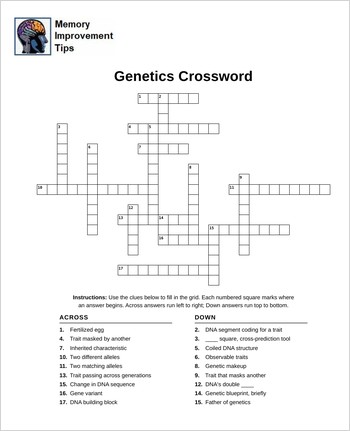
Crosswords aren't just classroom filler. Solving one is a quiet workout for your working memory: hold a clue in mind, scan your mental dictionary for terms that fit, cross-check letters from other answers, and revise your guesses as new information lands.
That cycle, repeated dozens of times in a single puzzle, is exactly the kind of cognitive engagement that strengthens recall.[1]
The biology crosswords on this page cover material commonly taught in high school biology and anatomy & physiology, from body systems to cells to genetics.
Print them for class, study sessions, or your own review. Each puzzle has 18 clues with an answer key.
Related Free Printables: Main Crosswords Hub, Word Searches, Bible Word Searches, Special Needs Word Searches, Mormon Word Searches, Sudoku Puzzles, Easy Crosswords
Available Biology Crosswords
Click any title to download the printable PDF. Solution PDFs are linked separately so you can print or hide the answer key as needed.
Cell Biology Crossword

Organelles, cell membrane, and the basic machinery inside every living cell.
Answer keyCellular Respiration Crossword
Glycolysis, the Krebs cycle, ATP, and how cells extract energy from food.
Answer keyDigestive System Crossword
Stomach, intestines, enzymes, and the journey from mouth to absorption.
Answer keyEcosystems Crossword
Producers, consumers, food webs, and the relationships that shape natural communities.
Answer keyGenetics Crossword
DNA, genes, alleles, dominant and recessive traits, and the basics of heredity.
Answer keyMuscular System Crossword
Skeletal, smooth, and cardiac muscle, plus key terms like contraction and tendon.
Answer keyNervous System Crossword
Covers the brain, spinal cord, neurons, and major divisions of the nervous system.
Answer keyPhotosynthesis Crossword
Chlorophyll, chloroplasts, light reactions, and how plants make their own food.
Answer keyRespiratory System Crossword
Lungs, alveoli, diaphragm, and the path of air through the body.
Answer keySkeletal System Crossword
Major bones, joint types, and the structure that supports the body.
Answer key
Many Ways to Use These Biology Crossword Puzzles

Years ago I worked as a technical writer at a software company, and a few times I had the chance to teach short classes to my department. Each session, I started with a five-minute word search or crossword puzzle. The point wasn't to teach anything with the puzzle. It was just to warm the room up.
In other words, pull people's attention away from whatever they'd been doing in the prior hour, get the brain engaged on something light before the real material started. It worked every time. People came in scattered but were quickly warm-up focused.
That's the spirit these biology crosswords are built in. They aren't a study system, and they aren't trying to replace flashcards or textbooks or a real review session. Each puzzle has 18 clues, which is a fraction of the vocabulary in any real biology unit.
What a puzzle does well is one specific thing: it pulls a few terms back out of memory through active recall, which is a slightly more durable form of cognitive engagement than re-reading.[2] Useful for warming up. Not enough to learn the unit on.
Practical ways to use them:
Five-minute warm-up at the start of class, to get engagement before the real lesson
Fun homework takeaway or sub-day filler that still touches course material
Study break that keeps your brain in the topic instead of pulling you out of it
For deeper study systems, my pages on active recall, spaced repetition, and learning strategies cover broadly applicable techniques that move material into long-term memory.
Solving Tips
For students new to crosswords, a few basic tactics make the puzzles less frustrating and more productive:
1) Start with the clues you know. Fill in any answers you're sure about. Those letters become hints for the words that cross them, which often unlocks the harder clues.
2) Use the letter count. Each answer's length is fixed by the grid. If a clue could be either "axon" or "dendrite," count the squares. Only one fits.
3) If you're stuck, skip and come back. The brain often solves a problem in the background. Move on, fill in other answers, and return to the stuck clue when more crossing letters are in place.
4) Use the answer key sparingly. Looking up the answer is faster but learns less. Try to retrieve the term first, even if it takes a minute. That effort is the part that builds memory.
For Teachers
You're welcome to print as many copies as you need for classroom use. As mentioned, the puzzles work as warm-up activities, study break or sub-day filler, or fun homework assignment. There's no login or attribution required to download and share these puzzles, though attribution is always appreciated.
More Crossword Categories
This page is part of a growing series of subject-specific crossword collections. Other categories are linked from the main printable puzzles page. The easy printable crosswords page has general-interest puzzles for casual solvers.
Terms of Use
These puzzles are free for personal use and for organizations, including classrooms, senior centers, memory care facilities, homeschool groups, clubs, churches, and workplaces. You may print as many copies as you need. Please don't sell them or remove the copyright notice.
Publishers: You may include one or two puzzles in each newsletter or bulletin with attribution to Memory-Improvement-Tips.com.
References & Research
I've reviewed these sources and selected them for their relevance to understanding why crossword puzzles support biology learning. Here's what each contributes:
1. Pillai, J.A., Hall, C.B., Dickson, D.W., et al. (2011). "Association of Crossword Puzzle Participation with Memory Decline in Persons Who Develop Dementia." Journal of the International Neuropsychological Society, 17(6), 1006-1013. Free full text at PMC
Researcher's Note: This longitudinal study from the Bronx Aging Study cohort followed older adults and found that those who reported regular crossword puzzle participation had onset of accelerated memory decline delayed by an average of 2.54 years. The finding is observational rather than causal, but it points to crossword-style cognitive engagement as a marker of healthy aging.
2. Roediger, H.L. III, & Butler, A.C. (2011). "The critical role of retrieval practice in long-term retention." Trends in Cognitive Sciences, 15(1), 20-27. Free PDF at Washington University
Researcher's Note: Roediger and Butler's review consolidates decades of evidence that actively retrieving information, the act every crossword clue requires, produces stronger long-term retention than re-reading or passive review. This is the cognitive mechanism that makes vocabulary crosswords genuinely useful for biology students, not just engaging.
Published: 05/03/2026
Last Updated: 05/03/2026
Newest / Popular
Multiplayer
Board Games
Card & Tile
Concentration
Daily Games
Math / Memory
Puzzles
Time Mgmt
Word Games
- Retro Flash -
Also:
Bubble Pop
• Solitaire
• Tetris
Checkers
• Mahjong Tiles
•Typing
No sign-up or log-in needed. Just go to a game page and start playing! 

Sudoku, Kakuro, Word Searches, Crosswords, Slitherlink & more!
Hundreds of printable puzzles you can download, print, and solve with pencil and paper.

Hippocampus? Working memory? Spaced repetition?
Look up memory or brain terms in the A-Z glossary of definitions.