- Home
- Brain Games
- Free Online Brain Games
- Bubble Flash Games
Bubble Pop Games: Free Online Bubble Shooters
Bubble shooters look simple, but they demand more from your brain than you'd expect. Every shot requires visual search (scanning a busy field for matching colors), spatial reasoning (calculating the trajectory of a curved shot, including bounces off walls), and planning (choosing which cluster to target for the best cascade).
It's a quick, low-stress cognitive workout disguised as a casual game. Pick one below and play; no login needed. For all game types, see the full games directory.

What Your Brain Does During a Bubble Shooter
When a new bubble loads into your cannon, your brain runs through several operations in rapid sequence. First, it identifies the color of the loaded bubble and scans the entire field to locate clusters of the same color. This is visual search, the same ability you use when scanning a crowded parking lot for your car or finding a friend's face in a crowd.
Researchers have found that games involving this kind of search, where you scan a visually complex field and pick out targets based on a specific feature like color, are closely linked to measurable visuospatial abilities.[1]
Next, you aim. Most bubble shooters let you bank shots off walls, which means you're calculating angles and estimating where the bubble will end up after a ricochet. This is spatial reasoning applied in real time. You're not solving a geometry problem on paper; you're making fast spatial judgments with immediate visual feedback on whether you were right or wrong.
Then comes the strategic layer. Experienced players don't just aim for the nearest color match. They target clusters that are supporting other bubbles, so that a single match causes a cascade of falling bubbles. This requires planning: looking ahead by one or two shots, weighing immediate gains against larger chain reactions, and managing the risk of a miss (which brings the bubble ceiling one row closer).
A 2009 review of cognitive benefits in older adults found that even relatively simple video games produced measurable improvements in reaction time and cognitive processing compared to non-gaming controls.[2]
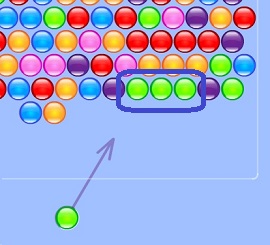
Every shot involves visual search, trajectory planning, and strategic decisions
How the Games Differ
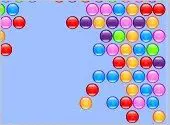
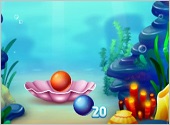
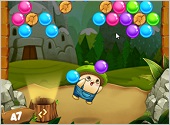
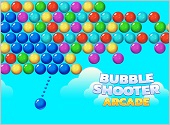
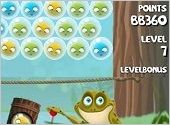
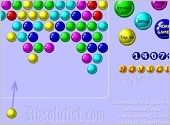
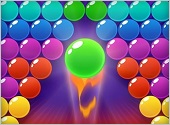
Classic bubble shooters (Aqua Bubble, Bubble Adventures, Bubble Arcade, Bubble Frog, Bubble Monkey, Bubble Shooter, Bubble Shooter Pro). These all follow the standard format: a cannon at the bottom, a field of colored bubbles descending from the top. Match three or more of the same color, and the group disappears. The differences are in pacing, visual style, and how aggressively the ceiling advances.
Some (like Bubble Arcade) use a countdown timer that penalizes misses, which adds time pressure to the visual search. Others (like Aqua Bubble) are more relaxed. If you're new to bubble shooters, start with Bubble Shooter. It's the most straightforward version and gives you time to think about each shot.
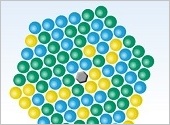
Bubble Spinner adds a twist to the formula: the cluster of bubbles rotates when you hit it. This means the spatial layout changes after every shot, forcing you to re-scan and recalculate angles. It's a small mechanical difference that significantly increases the spatial reasoning demand because you can't just memorize positions. The field is always shifting.
Bubble Tanks 3 is a different game entirely. Instead of a fixed-cannon shooter, you control a bubble tank that moves freely, defeats enemies, and grows in size and power over time. It's closer to an action game than a puzzle game, training reflexes and rapid decision-making rather than careful planning. If you enjoy this style, the concentration games section has more reflex-based challenges.
What the Research Shows
There's no published study specifically on bubble shooter games. But there is substantial research on the cognitive abilities that bubble shooters exercise, and the findings are encouraging.
A large study at the University of Illinois tested 209 participants on 20 casual video games and a battery of cognitive tests to identify which cognitive abilities each game type actually tapped. The researchers found that color-matching games (the same core mechanic as bubble shooters) were most strongly associated with visuospatial abilities and visual search performance.
These games correlated with participants' scores on standardized tests of spatial reasoning and perceptual speed, suggesting they genuinely engage these cognitive systems rather than just feeling like they do.[1]
Separately, a comprehensive review examined thirty years of research on video games and cognitive abilities. The evidence showed that even brief exposure to video games can improve visual selective attention, the ability to focus on relevant information while filtering out distractions.
The researchers found that this applied across a range of game types, not just fast-paced action games. Games that require repeated scanning of visual displays and making discrimination decisions (exactly what bubble shooters require) showed consistent links to enhanced attentional performance.[3]
For older adults specifically, the research is relevant because visuospatial processing speed is one of the cognitive abilities that declines most noticeably with age. A review focused on older adult gamers found that even simple video games from the 1990s produced measurable improvements in reaction time and cognitive performance. Modern casual games offer richer visual environments and more varied cognitive demands, and the review's authors suggested these could provide broader benefits.[2]
Getting the Most from Bubble Shooters
Aim for cascades, not just matches. The real planning challenge starts when you look beyond the immediate color match. Before you fire, check whether the cluster you're targeting is holding up other bubbles. A well-aimed shot that triggers a chain reaction exercises your planning ability more than clearing three bubbles in an easy spot.
Practice bank shots. Bouncing bubbles off the side walls is a core bubble shooter skill, and it's the part that most directly exercises spatial reasoning. When a direct shot isn't available, try to calculate the ricochet angle. You'll miss often at first, but the immediate feedback (seeing exactly where the bubble lands) helps you calibrate your spatial judgment over time.
Try Bubble Spinner for variety. The rotating board changes the visual search demand in a way that keeps your brain from settling into autopilot. If you've gotten comfortable with the classic format, the spinner variant introduces enough novelty to make the game challenging again.
Mix bubble games with other types. Bubble shooters primarily train visual-spatial processing. For a well-rounded cognitive routine, pair them with word games (language processing), puzzles (logical reasoning), or board games (strategic planning). The Brain Games guide explains how different game types target different skills.
More Free Brain Games
Looking for other types? The full games directory has 200+ games organized by category, including concentration games, memory games, math games, card & tile games, word games, puzzles, and time management games.
Published: 03/05/2016
Last Updated: 02/22/2026
Content on this page adheres to my editorial standards. See the medical disclaimer regarding health-related information.
References & Research
I've reviewed these sources and selected them for their relevance to understanding how casual visual games affect cognition. Here's what each contributes:
1. Baniqued, P. L., Lee, H., Voss, M. W., Basak, C., Cosman, J. D., DeSouza, S., Severson, J., Salthouse, T. A., & Kramer, A. F. (2013). "Selling Points: What Cognitive Abilities Are Tapped by Casual Video Games?" Acta Psychologica, 142(1), 74-86. Full text at PMC
Researcher's Note: This is the study that most directly connects casual game mechanics to measurable cognitive abilities. Researchers at the University of Illinois had 209 participants play 20 different casual games and complete a battery of standardized cognitive tests. Using statistical analysis, they mapped which game features predicted performance on which cognitive measures. Color-matching games (the same core mechanic as bubble shooters) loaded most strongly on visuospatial abilities. This matters because it means performance on these games reflects genuine cognitive skills, not just game-specific practice. The study used rigorous methodology including structural equation modeling and was funded by the Office of Naval Research.
2. Zelinski, E. M., & Reyes, R. (2009). "Cognitive Benefits of Computer Games for Older Adults." Gerontechnology, 8(4), 220-235. Full text at PMC
Researcher's Note: This review from the University of Southern California examines the full spectrum of evidence on video games and cognitive function in older adults. The authors cover studies dating back to the 1990s arcade-era games through modern strategy and action titles. Their key finding for casual games like bubble shooters: even simple video games produced measurable improvements in reaction time and cognitive performance in older adults compared to non-gaming controls. However, they also note that early simple games did not transfer to all cognitive tasks (for example, no improvement on the Stroop task), suggesting that the benefits are real but specific to the skills the games exercise. The paper also outlines how the principles of "extended practice training," which has the best evidence for producing far transfer to untrained cognitive tasks, map directly onto the mechanics of video game play.
3. Latham, A. J., Patston, L. L. M., & Tippett, L. J. (2013). "The Virtual Brain: 30 Years of Video-Game Play and Cognitive Abilities." Frontiers in Psychology, 4, 629. Full text at PMC
Researcher's Note: This comprehensive review consolidates three decades of research on how video game play affects cognitive function. For bubble shooter-style games, the most relevant findings involve visual search and selective attention. The review documents that gamers consistently show enhanced visual search efficiency and broader top-down search strategies. They also show improved visual selective attention, meaning a greater capacity to focus on target stimuli while filtering out irrelevant information. The authors are careful to distinguish between cross-sectional studies (comparing existing gamers to non-gamers) and training studies (having non-gamers play and measuring improvement), noting that both types show benefits but the training evidence is strongest for attention-related abilities.
Newest / Popular
Multiplayer
Board Games
Card & Tile
Concentration
Daily Games
Math / Memory
Puzzles
Time Mgmt
Word Games
- Retro Flash -
Also:
Bubble Pop
• Solitaire
• Tetris
Checkers
• Mahjong Tiles
•Typing
No sign-up or log-in needed. Just go to a game page and start playing! 

Sudoku, Kakuro, Word Searches, Crosswords, Slitherlink & more!
Hundreds of printable puzzles you can download, print, and solve with pencil and paper.

Hippocampus? Working memory? Spaced repetition?
Look up memory or brain terms in the A-Z glossary of definitions.